
The Woman Who Spoke for Apollo
- Civilization
- Greece
- Occupation
- The Pythia — oracle-priestess of Apollo
- Material
- Laurel & vapor
- Period
- c. 500 BC
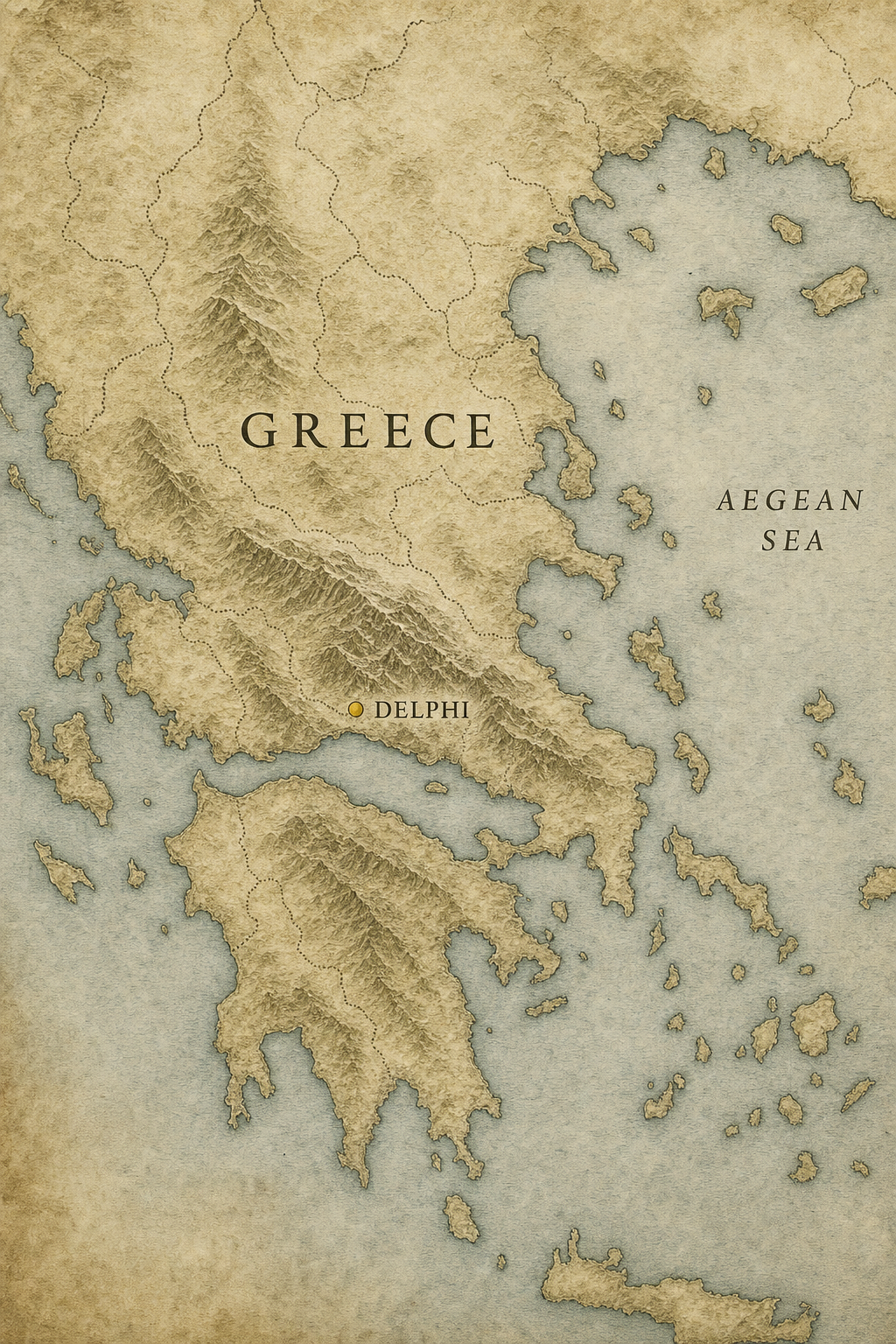
Kings crossed seas for one question. The Pythia prophesied from a bronze tripod over a cleft in the bedrock — one day a month, nine months a year. Croesus of Lydia asked if he should attack Persia and was told a great empire would fall. It was his own.
The job
On the seventh day of the month, nine months a year, one woman took her seat at the heart of the Temple of Apollo at Delphi. She was the Pythia, the priestess through whom the god was said to speak. She sat on a three-legged tripod in the adyton, the sunken inner chamber, above a cleft from which, the ancient sources say, rose a vapour the Greeks called pneuma. She breathed it, passed into trance, and answered.
No oracle in the Greek world was consulted more. Kings, generals and whole cities sent envoys to Delphi and shaped wars, colonies and laws around the replies. The office endured, in one form or another, for close to a thousand years.
What was the oracle of Delphi?
The oracle of Delphi was the sanctuary of Apollo on the slopes of Mount Parnassus, and the institution at its heart: for the better part of a thousand years, questions were put to the god there and answered through the Pythia, the priestess who spoke for him from the temple's inner chamber. The clients included kings. Croesus of Lydia tested the great oracles, judged Delphi the one that could be trusted, and asked whether he should march against Persia. The answers could be famously double-edged, and that one closed on him like a trap.
What does Pythia mean?
Pythia is a title, not a name. It comes from Pytho, the older name of Delphi itself, which Greek tradition tied to the serpent Python that Apollo killed when he claimed the sanctuary. The god's priestess at Delphi was therefore the Pythia, the woman of Pytho. Many women held the office across the oracle's long life, one at a time by rule. Plutarch, who held a priesthood at Delphi in the first century AD, says the sanctuary in its busiest age kept three, two to serve in turn and one in reserve. Tradition required her to be a local woman of Delphi, and once installed she served for life.
The office is why 'oracle of Delphi' can mean two things at once. Strictly, the oracle was the institution, the sanctuary of Apollo where answers were given, and the Pythia was Apollo's priestess inside it. In practice, Greek writers and the later tradition used the word for the woman herself, and both uses are ancient.
Who was the Pythia?
She was a real and local woman, and the office outlived every one of its holders. Plutarch, writing from inside the Delphic priesthood, says the Pythia of his own day came from one of the soundest households in Delphi and brought no special training to the tripod: what qualified her was an honest life, not a craft. Diodorus adds a rule with a story behind it. In early times the office went to a young woman, until a consultant named Echecrates the Thessalian fell for the priestess and carried her off. After that, Delphi ruled that the Pythia must be a woman past fifty, and she kept wearing a young woman's dress in memory of the older custom.
A few of the women have names. Tradition made Phemonoe the first Pythia, and credited her with the hexameter line the god's answers used. Herodotus names two more: Aristonike, who gave Athens the wooden wall answer before Salamis, and Perialla, who was put out of the office when her answer turned out to have been bought. The names are scattered across half a millennium. Everything between them belongs to women the record kept anonymous.
How the oracle of Delphi actually worked
A consultation followed a fixed procedure, and the fullest account of it comes from Plutarch, who was not guessing: he wrote about the oracle's workings from inside the priesthood. On a consultation day the Pythia purified herself in the Castalian spring. Before anyone asked anything, the priests tested whether the god was willing at all: a goat was sprinkled with cold water, and if it shuddered, the day could proceed. Plutarch records a day when the omen was forced against a listless goat. The Pythia went to the tripod unwillingly, answered in a strange harsh voice, and the session ended with the priestess screaming and collapsing. She died within days. Whatever caused the trance, no source treats it as theater.
Consultants drew lots for their place in the line, unless their city held promanteia, the right to consult first, which Delphi granted as an honor. They paid a fee and made an offering before the question went in. The questions themselves were mostly practical: whether to found a colony, make a war, free a slave, marry. The Pythia answered from the tripod, and the temple staff rendered the answer to the consultant, in famous cases as verse. How much shaping the priests did on the way is one of the oldest arguments in classical scholarship, and it is still open.
The days the oracle spoke drew crowds big enough to feed a whole industry on the slope below the temple, professional guides included. That trade has its own episode: The Guides Nobody Could Stop.
The Croesus test
The most famous consultation was a trap that closed on the man who set it. Croesus, king of Lydia, first tested the great oracles and judged Delphi the one that could be trusted. Then he asked the real question: whether he should march against the rising power of Persia.
The Pythia answered that if he attacked, he would destroy a great empire. Croesus crossed the river Halys, gave battle, and lost. The great empire that fell was his own. Herodotus, who preserves the story, treats the reply not as a fraud but as a riddle the king was too eager to read in his own favour.
The gas beneath
For a long time the vapour was the least credible part of the account. When French archaeologists excavated the temple in the 1890s they found no chasm and no gas, and many scholars concluded the ancient writers had imagined it. In 2001 a geologist, an archaeologist and a chemist reopened the case. De Boer, Hale and Chanton reported two intersecting faults beneath the sanctuary and light hydrocarbon gases — methane, ethane and ethylene — in the spring water and the travertine crust around it. Ethylene was the arresting detail: sweet-smelling, once used as a surgical anaesthetic, and capable of producing euphoria and trance in small doses. A 2002 paper defended the reconstruction across geology, chemistry and the texts.
The identification is not settled. A 2006 survey of the site found mainly methane, ethane and carbon dioxide, and proposed that the sweet scent the ancients described came from benzene rather than ethylene. In 2007 a philosopher and a classicist argued that the measured concentrations were far too low to intoxicate anyone, and that the textual case had been overstated. The geological setting is now broadly accepted. The exact gas, and whether gas alone can explain what the Pythia did, remains open.
The last prophecy of Delphi
The story of the oracle's end is carried by Byzantine chroniclers. Around 362 AD the emperor Julian, the last pagan on the Roman throne, sent his physician Oribasius to restore Delphi, and the reply he brought back reads like the office writing its own epitaph: tell the king the fair-wrought hall has fallen. Phoebus no longer has his house, nor his prophetic laurel, nor his speaking spring. Even the talking water has gone quiet.
The lines first surface in Christian sources centuries after Julian, and historians still argue whether they preserve a genuine reply or a verdict composed after the fact. Either way the dates close in on the same decade: within a generation Theodosius shut the old sanctuaries, and an office that had spoken for close to a thousand years went silent for good.
Where is the oracle of Delphi today?
The chamber is gone, but Delphi survives. The Temple of Apollo still stands above the sacred way, and a copy of the omphalos, the stone that marked the centre of the world, sits where the god's was kept. The originals are a short walk downhill in the Delphi Archaeological Museum: the carved omphalos, the archaic Sphinx of the Naxians, and the acanthus column of the Dancers that once carried a bronze tripod.
Sources
- de Boer, Hale & Chanton — New evidence for the geological origins of the ancient Delphic oracle (Greece) (2001), Geology 29(8): 707–710
- Spiller, Hale & de Boer — The Delphic Oracle: A Multidisciplinary Defense of the Gaseous Vent Theory (2002), Journal of Toxicology: Clinical Toxicology 40(2): 189–196
- Etiope et al. — The geological links of the ancient Delphic Oracle (Greece): a reappraisal of natural gas occurrence and origin (2006), Geology 34(10): 821–824
- Foster & Lehoux — The Delphic Oracle and the ethylene-intoxication hypothesis (2007), Clinical Toxicology 45(1): 85–89
- Herodotus — Histories 1.53, the Croesus oracle (Godley ed.), Perseus Digital Library
- Hellenic Ministry of Culture — Archaeological Site of Delphi (official)
- Plutarch — De defectu oraculorum (The Obsolescence of Oracles), Moralia: the three Pythiai of the flourishing age (414b), the goat test (435b, 437b) and the fatal forced session (438a-b). Loeb translation at LacusCurtius
- Michael Scott — Delphi: A History of the Center of the Ancient World (Princeton UP, 2014): the consultation procedure, lots and promanteia
- Diodorus Siculus — Library of History 16.26, the origin of the office (Loeb ed., LacusCurtius)
- Pausanias — Description of Greece 10.5-6, Phemonoe and the first temples (Jones ed., Perseus)
- T. E. Gregory — 'Julian and the Last Oracle at Delphi', Greek, Roman and Byzantine Studies 24 (1983)
Tell us in the comments — the next episode is picked from what you ask for.
Subscribe on YouTube Watch the seriesMore from the series

The Pearl Divers of Dilmun

The Bead-Borers of the Indus Valley