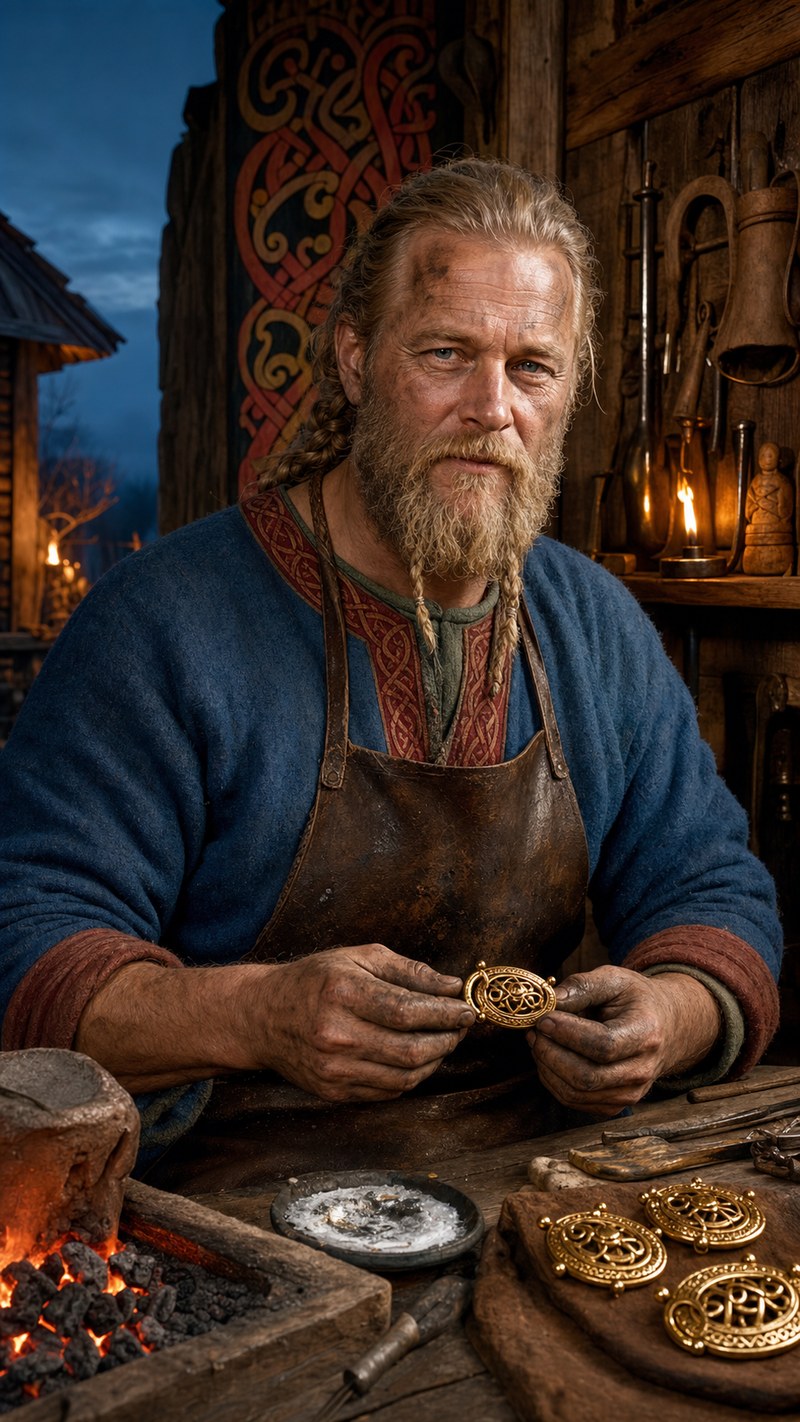
fire gilding
- Civilization
- Viking Age
- Period
- c. 900 AD
Fire gilding, also called mercury gilding or amalgam gilding, bonds a film of real gold to a metal object. Gold ground into mercury makes a cold, silvery paste. Painted onto cleaned bronze and held over charcoal, the mercury boils away at about 357 degrees Celsius and leaves a thin layer of gold chemically bonded to the surface, ready to be burnished to a mirror.
The technique is ancient and was astonishingly stable: the same amalgam process runs from antiquity to the 1840s, when electroplating displaced it, not because it gilded better, but because it did not poison the workshop. Mercury vapor is a cumulative neurotoxin. Ramazzini's founding treatise of occupational medicine lists gilders among the mercury-poisoned trades in 1700, and France banned fire gilding outright in 1830.
In the Viking age the technique gilded the mass-produced bronze brooches of ordinary households. Analyzed brooches show the tell-tale pairing of gold with residual mercury, and mercury traces have been excavated in the workshop deposits of York and Hedeby. One hedge belongs here: at trading towns mercury was also used to assay precious metal, so a trace marks mercury use rather than proving a gilding bench on that exact spot.