
The Fire-Gilders of Kaupang
- Civilization
- Viking Age
- Occupation
- Fire-gilder of Kaupang
- Material
- Gold & quicksilver
- Period
- c. 900 AD
Gold does not stick to bronze — it must be carried. A Viking-age goldsmith carried it in quicksilver: a cold amalgam painted onto cast bronze brooches, then driven off over charcoal as mercury vapor, leaving a bonded skin of gold. The brooches that gleamed like a jarl's treasure were mass-produced for farmers' wives — and the smoke that fixed the gold was a slow, cumulative hazard the trade would carry for another nine hundred years.
The job
The fire-gilder solved a real problem of chemistry with a dangerous trick: gold will not simply stay on bronze, so it was carried there in mercury. Gold ground into quicksilver makes a cold, silvery paste — medieval craft texts treat the recipe as routine — which the smith painted onto a cast copper-alloy brooch. Held over charcoal, the mercury boils away at about 357 °C as an invisible-to-white vapor, and a thin film of gold is left chemically bonded to the bronze, ready to be burnished to a mirror. The technique is ancient and astonishingly stable: the same amalgam process runs from antiquity to the 1840s, when electroplating finally displaced it — not because it gilded better, but because it did not poison the workshop.
The Viking-age evidence is physical. Brooches analyzed by X-ray fluorescence show copper-alloy bodies carrying the tell-tale pairing of gold with residual mercury, and mercury traces have been excavated in the workshop deposits of York's Coppergate and the great emporium of Hedeby. One honest hedge belongs here: at trading towns, mercury was also used to assay gold and silver on touchstones, so a mercury trace marks mercury *use* — including fire-gilding — rather than proving a gilder's bench on that exact spot.
The middle-class gold
The gilder's customers were not kings. Solid gold and silver belonged to the aristocracy; the oval and tortoise brooches that fastened the strap-dresses of free farmers' wives were cast bronze, gilded to gleam like a jarl's hoard. They were also mass-produced: clay-mould fragments from Trondheim prove that identical brooches were cast from shared moulds, some of them then gilded, and the commonest oval-brooch types survive in the thousands. Viking Scandinavia had, in effect, an aspirational jewelry industry — standardized, workshop-made, distributed along the same routes that moved silver and slaves — and the fire-gilder was its finishing step. The gilded oval brooch in this film is a real object: a Scandinavian piece of 900–1000 AD in The Metropolitan Museum of Art (acc. 1982.323.1, CC0).
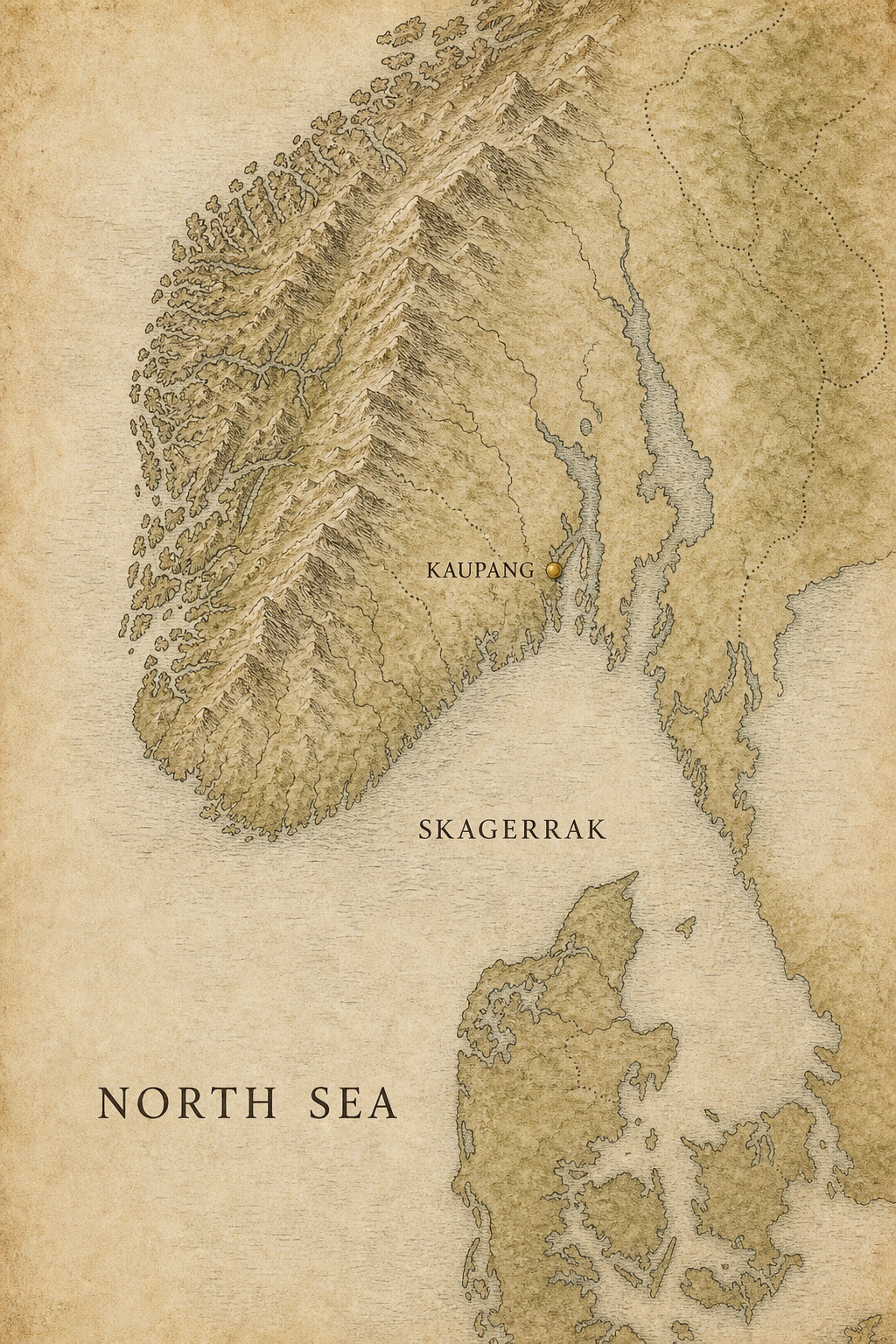
The episode sets the workshop at Kaupang in Vestfold — Norway's first town and its gateway market in the decades around 900 AD, with excavated urban plots and intensive craft production including non-ferrous metalworking. The gilding evidence itself is strongest at York and Hedeby; Kaupang stands for the world such a craftsman worked in, not a specific excavated gilding bench.
How fire gilding works, and what it cost
Mercury vapor is a cumulative neurotoxin, and the historical record of what it did to gilders is unambiguous — but it is an eighteenth-century record, not a Viking one. Bernardino Ramazzini's De Morbis Artificum Diatriba (1700), the founding treatise of occupational medicine, lists gilders among the mercury-poisoned trades, describing the trembling hands and shattered nerves of men who worked over the amalgam pan. France banned fire gilding outright in 1830. The Viking-age gilder breathed the same smoke over the same charcoal; no excavated skeleton yet ties a Viking craftsman's harm to gilding, and mercury measured in later medieval Scandinavian bone is attributed to mercury medicine and cinnabar ink rather than the gilding hearth. The film keeps that honest: the hazard is stated as the trade's, the tremor as the trade's memory — 'the steadiest young hands are rarely the steadiest old ones' — not as one man's diagnosis.
Sources
- The Met — Fire Gilding of Arms and Armor (technique essay)
- The Met — Gilded copper-alloy oval brooch, Scandinavia, 900–1000 AD (acc. 1982.323.1, CC0)
- ScienceNorway — X-ray analysis of a Viking-age brooch: copper alloy with traces of mercury and gold
- Regia Anglorum — Non-ferrous metalworking in the Viking age (York/Coppergate & Hedeby mercury evidence)
- Pedersen, U. — Into the Melting Pot: non-ferrous metalworkers at Kaupang (Kaupang Excavation Project)
- Baars et al. — Crucible metallurgy at Ribe: 1,126 samples from the 8th–9th-c. workshops (Archaeol Anthropol Sci)
- Ramazzini, De Morbis Artificum Diatriba (1700) — gilders among the mercury-poisoned trades
- PMC — Occupational mercury poisoning in gilders: the historical record
Tell us in the comments — the next episode is picked from what you ask for.
Subscribe on YouTube Watch the seriesMore from the series
The Salt Hearts of Hallstatt

The Pearl Divers of Dilmun