The Pearl Divers of Dilmun
- Civilization
- Dilmun
- Occupation
- Pearl diver of the Gulf banks
- Material
- Nacre & stone
- Period
- c. 2000 BC
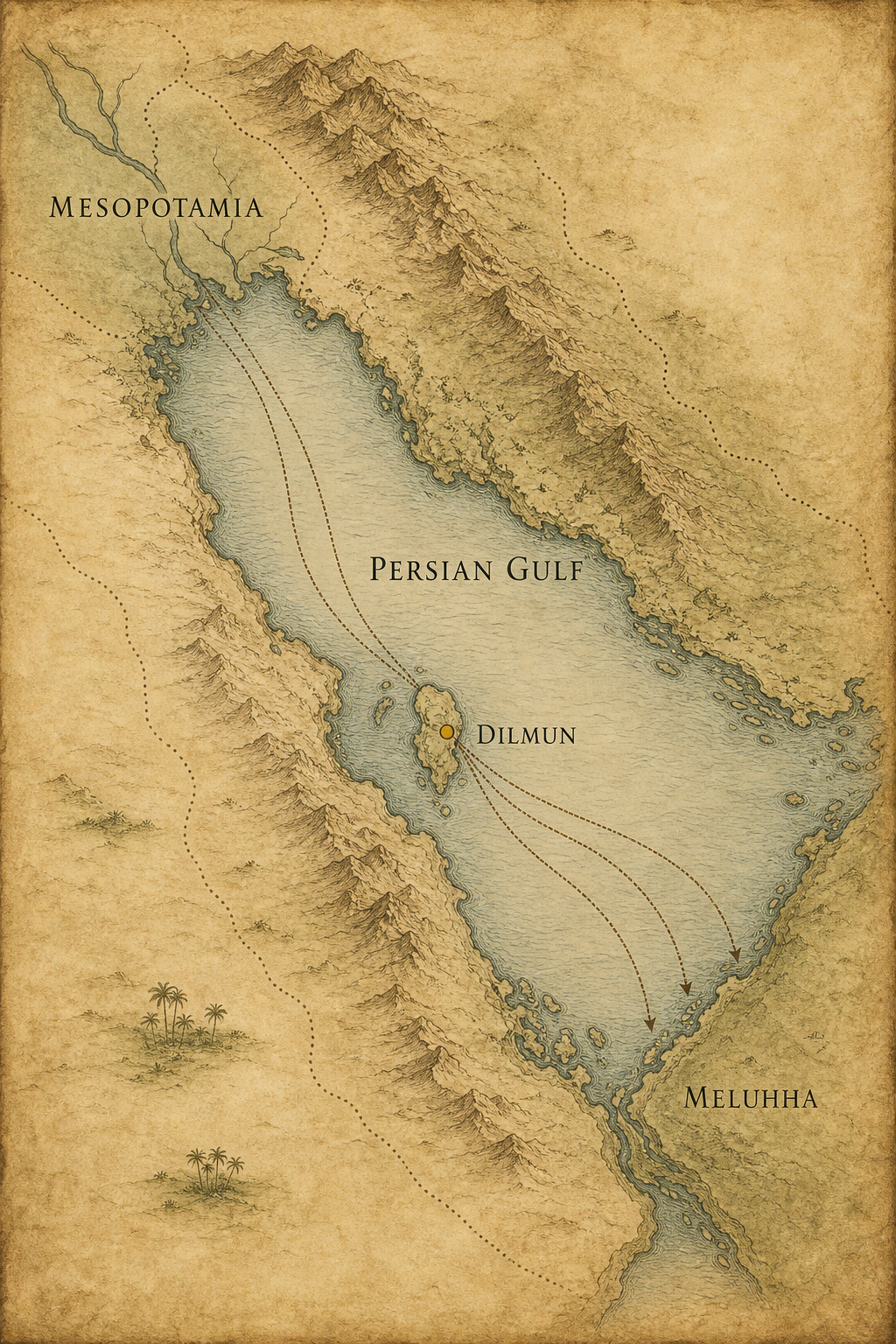
One breath, a weighted stone, and a thousand shells for a single pearl. A diver of Dilmun — the Bronze-Age trade kingdom on Bahrain — worked the oyster banks blind on held breath. When archaeologists opened the houses of one Dilmun town, they found 514 pearls still inside.
The job
The pearl banks of the Gulf lie a few fathoms down — close enough to reach on one breath, deep enough that every trip is a wager against your own lungs. The diver's whole kit was a weighted stone on a rope to pull him to the bottom, a bag or basket for the shells, and, in the documented tradition, a turtle-shell clip for his nose. He worked blind and fast: pry loose what you can, bag it, ride the rope back to the light. Pliny the Elder, writing in the first century AD, already describes the divers of Tylos — the classical name for Bahrain — working the banks from boats and rafts, and when European travellers described Gulf pearling in the nineteenth century, the method they saw was essentially the same one. Few trades anywhere have run so long with so little change.
What made the risk worth it is brutal arithmetic: only a fraction of pearl-oysters hold a pearl at all, and only a fraction of those hold one worth keeping. A good pearl was concentrated wealth — small, imperishable, and portable across any border.
Fish-eyes
Mesopotamian trade lists speak of goods from Dilmun, and among them appears a term many Assyriologists read as ‘fish-eyes’ — igi-ku₆ — which since the 1930s has often been taken to mean pearls. The reading is genuinely contested: other scholars have argued the term meant something else entirely, and no text spells it out. What is not contested is that Dilmun sat at the centre of the Gulf's sea-trade — copper from Oman, carnelian and beads from the Indus, silver and textiles from Mesopotamia — and that pearls were part of the Gulf's wealth from very early on. By classical times there was no ambiguity left: Theophrastus and Pliny both name the Gulf as the source of the finest pearls in the world.
What the spades found
The archaeology is more eloquent than the texts. At Al-Markh, a small site on Bahrain from the late fifth millennium BC, roughly two-thirds of the shell refuse is pearl-oyster — a community that lived off the banks seven thousand years ago. On Marawah Island off Abu Dhabi, excavators recovered a whole natural pearl nearly eight thousand years old, the Gulf's oldest known. And at Saar, a Dilmun town of c. 2000–1800 BC, the houses themselves gave up 514 loose, unpierced pearls — one merchant's house held pearls alongside goods of the Indus trade. Pearls were not palace treasure locked in a hoard; they were sitting in ordinary homes, a working town's savings account, waiting four thousand years to be found.
That find is the episode's closing line. The sea paid Dilmun well — and the payment is still coming out of the ground.
The history of pearl diving in Bahrain
Pearl diving in Bahrain runs in one documented line from the shell middens of the fifth millennium BC to the last free-diving fleets of the 1930s. Pearling remained the Gulf's defining industry into living memory. Before oil, pearl fleets were the region's economic engine — Bahrain's above all — until the 1930s, when Japanese cultured pearls collapsed the market almost overnight. The free-divers of that last generation used the stone, the rope, the nose-clip and the breath, as their predecessors had when the towns of Dilmun were young. This episode was requested by a viewer — a reminder that the best commissions come from the comments.
Sources
- Beech, Cuttler & Al-Sindi — Pearl fishing in Bahrain: archaeological and historical evidence, Arabian Humanities
- “Pearl” — Dictionary of Ancient Arabia (the contested igi-ku₆ ‘fish-eyes’ reading)
- DCT Abu Dhabi — the ‘Abu Dhabi Pearl’ of Marawah Island, the Gulf's oldest known natural pearl (~5800–5600 BC)
- Pliny the Elder — Natural History 9.54–56 on Gulf pearls and the divers of Tylos (Bahrain)
- Qatar National Museums — fatam (pearl diver's nose clip), the traditional dive kit
- Barbar Temple, Bahrain — the Dilmun sanctuary (background on Dilmun's material world)
Tell us in the comments — the next episode is picked from what you ask for.
Subscribe on YouTube Watch the seriesMore from the series

The Fire-Gilders of Kaupang
The Woman Who Spoke for Apollo