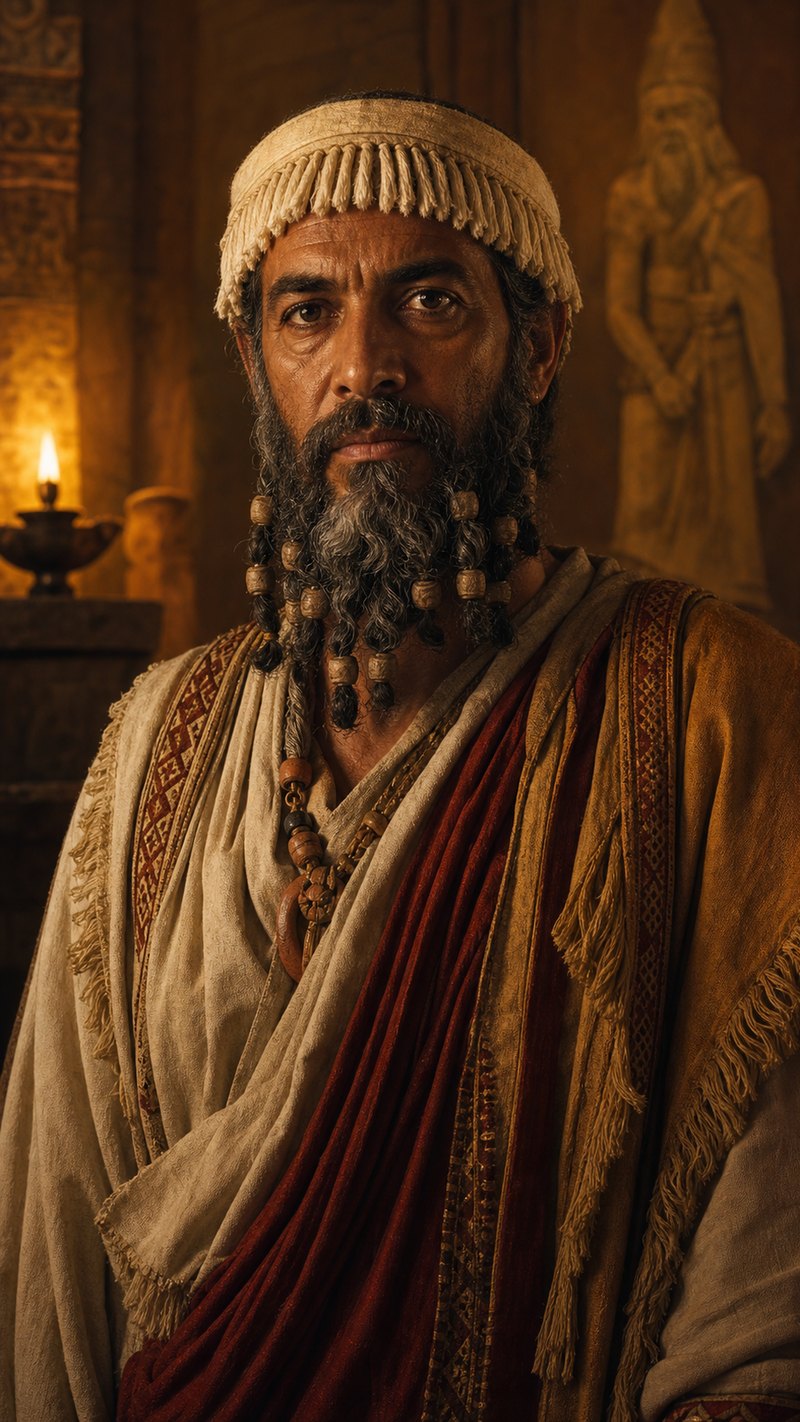
The Man Who Wrote Down Every Excuse
- Civilization
- Egypt
- Occupation
- Scribe of the Tomb (attendance scribe)
- Material
- Limestone, black & red ink
- Period
- c. 1250 BC
British Museum ostracon EA5634 is a limestone flake the size of a serving tray, ruled into a workmen's register for Year 40 of Ramses II. Forty tomb-builders, 280 covered days, and above the black date-lines a running column of red-ink reasons: illness, brewing beer, building his house, fetching stones for the scribe, a scorpion bite — and one man drinking with a colleague whose own row confirms he was throwing his feast that day. By the museum's count, only about seventy of the covered days were fully worked. Eighty years later, in the same village, late grain wages produced the earliest fully documented labour strike known so far.
An office in the desert
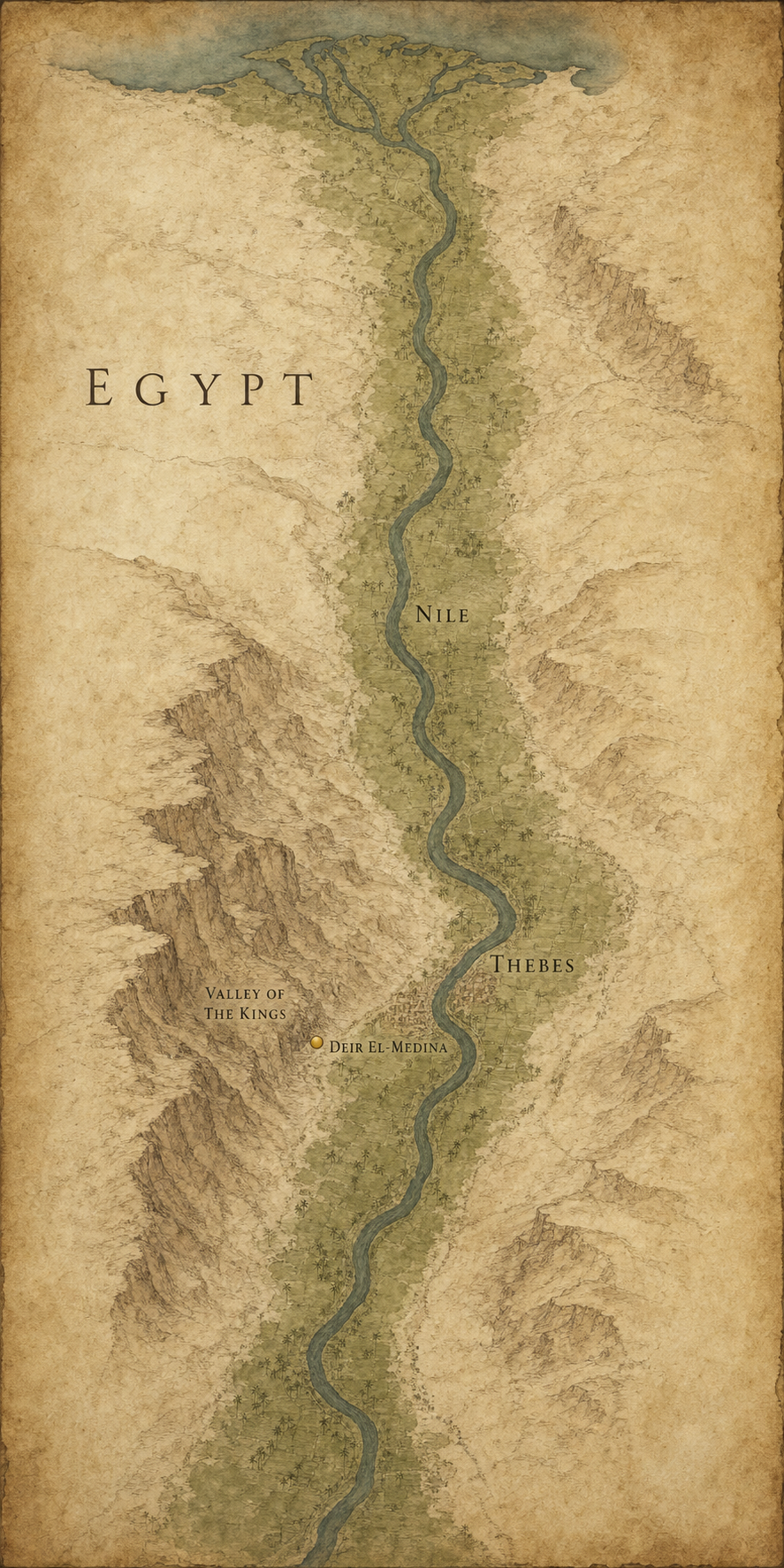
Deir el-Medina was a company town in the cliffs of the Theban west bank: a walled village of roughly sixty-eight houses whose men cut and decorated the royal tombs in the Valley of the Kings. The crew was organised like a ship's company — a left gang and a right gang, a foreman for each, and over the paperwork a 'scribe of the Tomb' who tracked attendance, tools, lamp wicks and grain wages for the state. Wages arrived monthly as grain rations — around four sacks of emmer and one and a half of barley for an ordinary workman, more for foremen and the scribe — supplemented by fish, vegetables, water deliveries and festival extras.
Because the village was unusually literate and wrote on stone flakes that cost nothing, its day-to-day administration survives in extraordinary density: attendance lists, work journals, ration accounts, laundry lists, loans, lawsuits, love songs. The result is the best-documented working community of the ancient world.
The register in black and red
British Museum EA5634 is a limestone ostracon 38.5 by 33 centimetres, labelled Year 40 of Ramses II — about 1250 BC. Forty workmen's names run down the right edge of each side; after each name, the days that man missed are written in black ink, and above most dates a word or phrase in red gives the reason. The British Museum's curators note that the list was probably compiled from a day-to-day rota kept on smaller ostraca, that it likely covers the year before it was written up — and that only about seventy of the 280 covered days appear to have been full working days.
Ancient Egyptian excuses for missing work
The red column is the ancient Egyptian master list of excuses for missing work, a taxonomy of everything that could keep a person from it. Illness is the most common entry by far — over a hundred instances, including 'suffering with his eye' and, for the workman Seba, 'the scorpion bit him.' Family duty follows: wrapping and embalming deceased relatives, libating for a dead father or son, mourning. Religious obligation: 'offering to the god,' 'his feast.' Household economics: 'building his house,' 'strengthening the door' (Amenemwia's entry), and — repeatedly, in clusters on the same dates across several men — 'brewing beer,' which in New Kingdom Egypt was a staple duty with festival deadlines, not a bender. Several men are marked simply 'off absent,' no reason recorded. And a large class of entries reads 'with his boss': private work for a superior, apparently tolerated in moderation.
A few entries record that a workman's wife or daughter 'was bleeding.' The Egyptian term (hsmn) is often read as menstruation, which would make these among the earliest recorded menstrual-leave entries — but as T. G. Wilfong's study of the term stresses, both the reading and its social meaning remain debated, so we state it here as the museum renders it and no further.
Drinking with Khonsu, and the morning after
The register's most quoted line is its first: 'Year 40, Penduauu: month 1 of Spring, day 14 — drinking with Khonsu.' What the viral versions never mention is that the register checks its own receipt. A workman named Khonsu appears on the back of the same ostracon, and his row for that exact date reads 'his feast' — two days of it. Penduauu's excuse, in other words, is corroborated one column over: Khonsu threw his feast, and Penduauu was there drinking. (Whether 'Khonsu' names the colleague or the god's festival is a live scholarly question; the matching crewman's row makes the colleague the natural reading, and it is the one we adopt — as a reading, not a fact.)
Then there is the crew's doctor. Paherypedjet's absence row is effectively a patient log — 'with Aapehti, making remedies' on exactly the days Aapehti's own row records him ill, 'making remedies for the scribe's wife' for two straight weeks. On day 15 of that same first month of Spring — the morning after Khonsu's feast began — the doctor himself reported ill, and again on day 16 (the museum marks the second date with a query). The register asserts nothing. It just puts the dates side by side, three thousand years before anyone could ask him about it. As our scribe puts it: every man has an excuse. Some are true.
The register-keeper's own errands
The scribe alluded to in the document is Qenherkhepshef, one of the best-attested bureaucrats of the ancient world — and the register he kept quietly indicts him. Several men's absences read 'fetching stone for the scribe,' and one names him outright: 'fetching stone for Qenherkhepshef.' The man keeping the attendance sheet was also pulling crew off the king's tomb to haul stone for his own projects, and logging it in his own register. Papyrus Salt 124, a formal complaint from the same village a generation later, shows that misuse of crew labour was a recognised category of misconduct — recognised, and evidently routine.
Eighty years later: the strike
Around 1157 BC, in Year 29 of Ramses III, the system behind the register failed. The grain wages of the same village ran eighteen days late, and the tomb crews put down their tools, walked past the necropolis checkpoints, and staged sit-ins at the mortuary temples — declaring, in the words the scribe Amennakht recorded on what is now the Turin Strike Papyrus, 'we are hungry.' Officials made partial payments; the men went back; the payments failed again; the men walked out again. It is the earliest fully documented labour strike known so far — and it reads less like an uprising than like a payroll dispute, escalated through channels, minuted by the office.
Ozymandias kept an attendance sheet
One more turn of the screw. 'Ozymandias' is the Greek rendering — via the historian Diodorus Siculus — of Usermaatra, the throne name of Ramses II: the register's Year 40 is his. And one of the temples the strikers occupied eighty years later was the Ramesseum, Ramses II's own mortuary temple, whose fallen colossus later fed the legend behind Shelley's poem. Look on my works, ye Mighty: the works had a sick-day list, the excuses were filed in red ink, and when payroll ran late the men who built the works sat down in the king of kings' own temple until somebody paid them.
Sources
- British Museum, ostracon EA5634 — object record with full inscription translation
- Museo Egizio, Turin — P. Turin Cat. 1880, the 'Strike Papyrus'
- Edgerton, 'The Strikes in Ramses III's Twenty-Ninth Year' — JNES 10.3 (1951)
- McDowell, 'Village Life in Ancient Egypt: Laundry Lists and Love Songs' (Oxford, 1999)
- Museo Egizio, Turin — Suppl. 9619, Journal of the Necropolis ostracon (absence of workmen)
- Trismegistos 136354 — EA5634 text record
- The Deir el-Medina Database (Leiden University)
Tell us in the comments — the next episode is picked from what you ask for.
Subscribe on YouTube Watch the seriesMore from the series
The Engineer Who Farmed the Flash Flood
The Men Who Rowed Out to Harvest the Sea's Oil