
The Engineer Who Farmed the Flash Flood
- Civilization
- Nabataea
- Occupation
- Hydraulic engineer (water master)
- Material
- Terracotta & lime plaster
- Period
- c. 100 BC
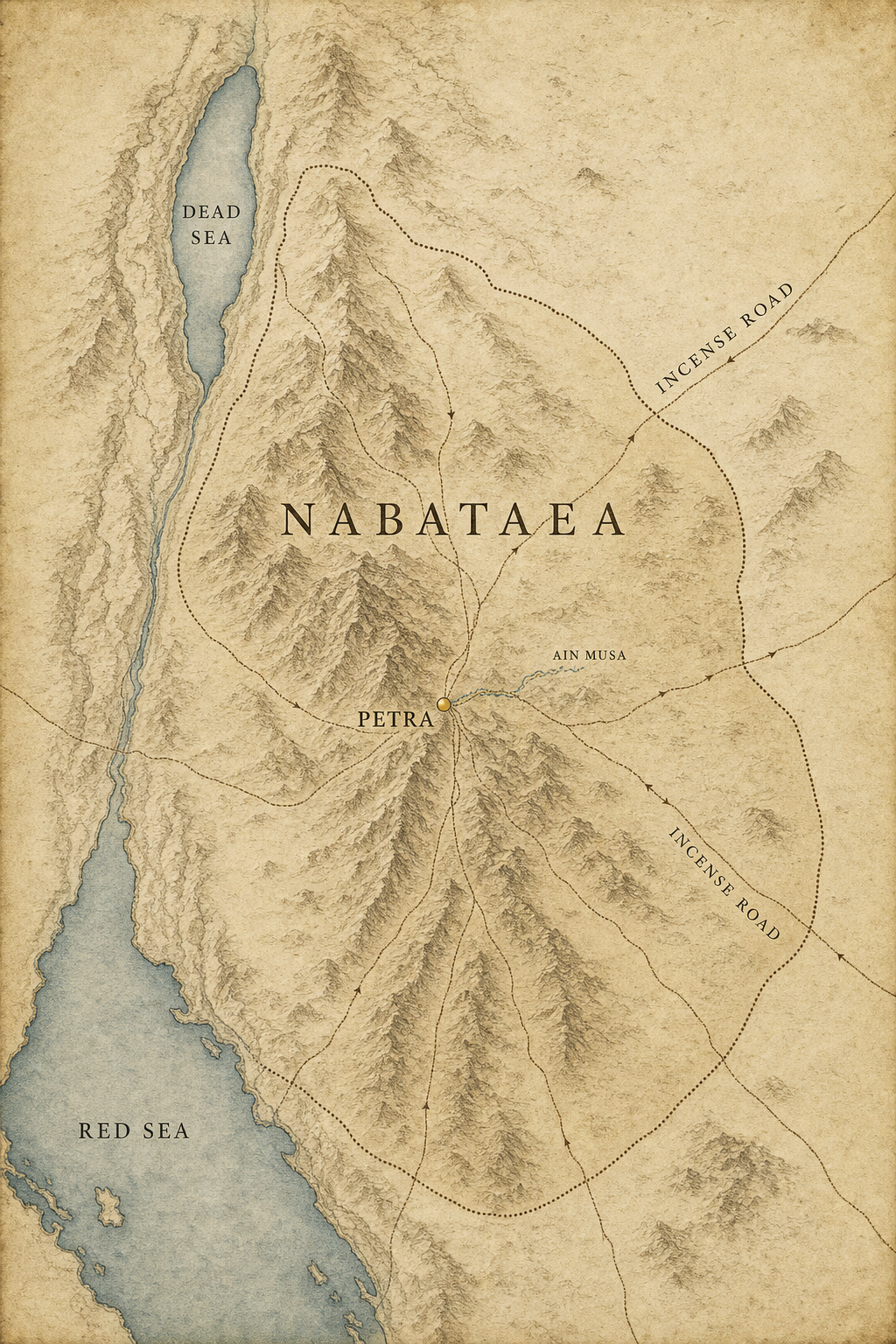
Petra gets roughly 193 millimetres of rain a year, most of it in violent winter bursts. The Nabataeans met that desert arithmetic with engineering: dams that turned flash floods aside, a diversion tunnel through solid rock, kilometres of channels and socketed terracotta pipes riding the canyon walls, and — in the standard scholarly reconstruction — more than two hundred cisterns and reservoirs. The result was fountains, gardens and a great pool in the heart of one of the driest cities on earth.
A city that should not exist
Petra sits in a sandstone basin in southern Jordan that receives on the order of 193 millimetres of rain a year — a long afternoon of English drizzle, delivered mostly in a handful of violent winter storms. A flash flood in a slot canyon like the Siq, Petra's kilometre-long entrance gorge, can rise faster than a person can run. The same water that threatened the city was also the only water there was. Nabataean engineering treated those two facts as one problem: the flood was not something to survive but something to harvest.
Turning the flood
At the mouth of the Siq the Nabataeans built a dam that closed the gorge to floodwater and shunted it into a tunnel — roughly 86 metres cut through rock — that carried the torrent around the city by way of a side wadi. Check-dams terraced the tributary valleys, slowing runoff and banking silt into farmable pockets. What had been the city's chief hazard became its recharge system: floodwater was steered, slowed and stored rather than endured. The dam visible at the Siq entrance today is a modern reconstruction of the Nabataean installation, rebuilt by engineers in 1963 and reinforced in 1991.
The pipes that rode the canyon walls
Day-to-day supply came from springs — chief among them Ain Musa, roughly seven kilometres from the city centre — carried in by rock-cut channels and runs of socketed terracotta pipe, each section around a third of a metre long, seated in a carved gutter along the Siq wall and sealed with hydraulic mortar. C.R. Ortloff's analysis of the network argues the builders tuned slope and diameter to keep water running just below each pipe's capacity: open-channel flow inside a closed pipe, which avoids the pressure that bursts joints. Sequential settling basins dropped the silt out before the water reached the city's fountains. Estimates in the scholarly literature put more than two hundred cisterns and reservoirs across the basin, with total conduit length in the low hundreds of kilometres; per-capita delivery figures quoted in popular accounts (a common one is 360 litres a head per day) are secondary estimates rather than measured fact, and we have kept them out of the film.
The work of a water master
No Nabataean job manual survives; what the film shows is inferred from what the system demanded. Porous sandstone cisterns and channels had to be lined with lime plaster and re-lined as it cracked. Settling basins silted up after every storm and had to be dug out. Pipe sections split and had to be replaced; junction basins needed their flows balanced season by season. The network was not a monument but a machine, and a machine in the desert is only ever as good as its maintenance. The scale of the system implies organised, skilled crews under some form of central management — the anonymous professionals this episode gives a voice to.
What the desert did after
The earthquake of 19 May 363 AD wrecked buildings across Petra and, with them, parts of the water infrastructure; maintenance never fully recovered, and the city's decline had in any case begun as sea routes drew the incense trade away from the caravan roads. Byzantine Petra lived on at a smaller scale before the city was largely abandoned. The gardens went back to sand. The rain, of course, kept coming — and on 8 April 1963 a flash flood in the Siq killed twenty-three French tourists, a modern demonstration of exactly the force the Nabataean water masters had tamed. That same year, engineers rebuilt their dam.
Sources
- Ortloff, 'The Water Supply and Distribution System of the Nabataean City of Petra' — Cambridge Archaeological Journal 15 (2005)
- Ortloff, 'Water engineering at Petra: recreating the decision process' — Journal of Archaeological Science 44 (2014)
- Nabataean water management (overview with the 8-springs / 200+ cisterns / ~200 km reconstruction)
- The Siq: dimensions, channels and the reconstructed entrance dam
- Le Monde, 11 April 1963 — the Siq flash-flood disaster
- Met Museum — the Nabataeans and the incense trade
Tell us in the comments — the next episode is picked from what you ask for.
Subscribe on YouTube Watch the seriesMore from the series

The Diviner Who Read Tomorrow in a Sheep's Liver
The Man Who Wrote Down Every Excuse