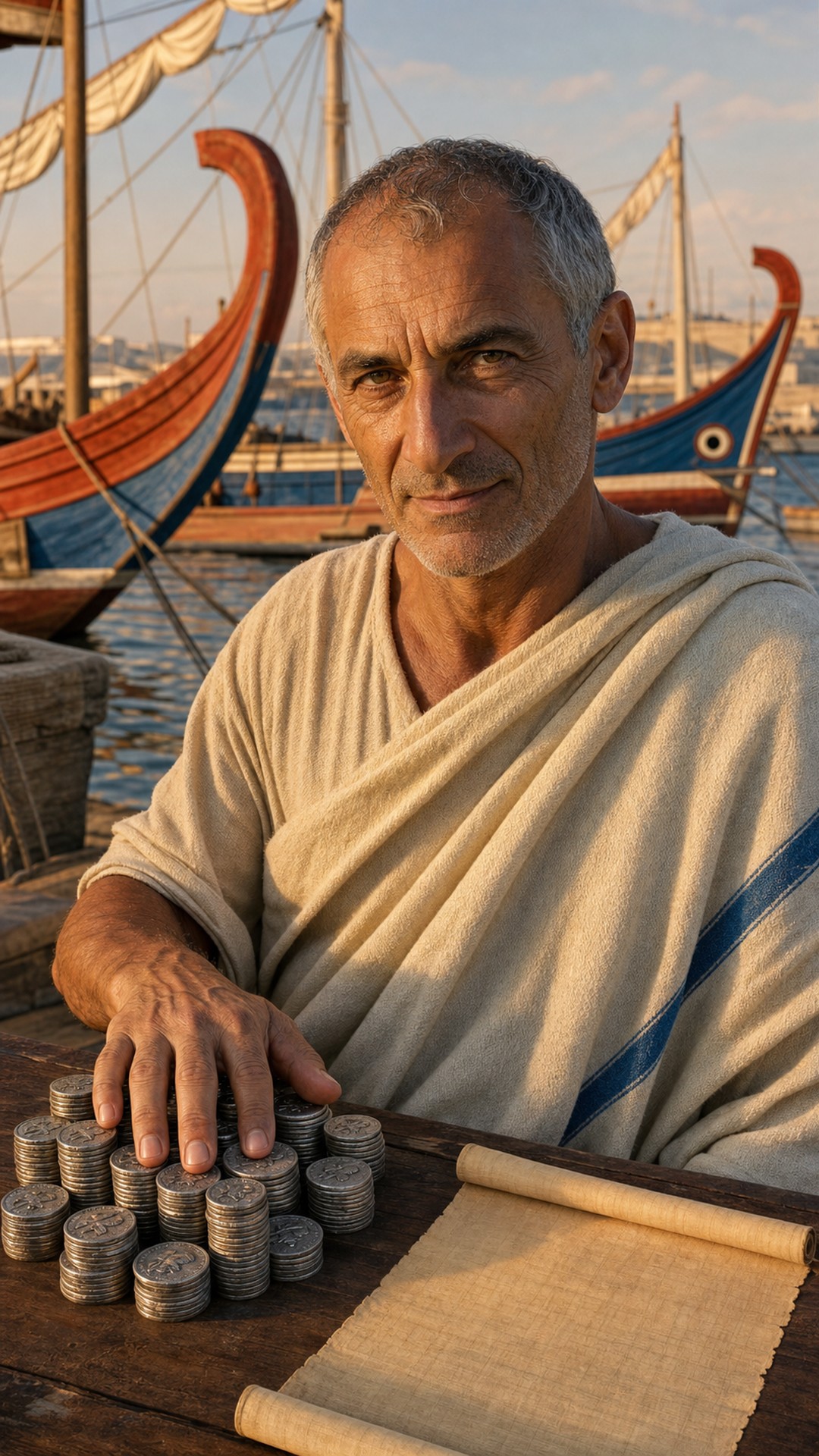
The Stone Was the Appointment
- Civilization
- Anatolia
- Occupation
- Stone hauler, on the rope crew of the world's oldest monumental build
- Material
- Limestone & grain
- Period
- c. 9500 BC
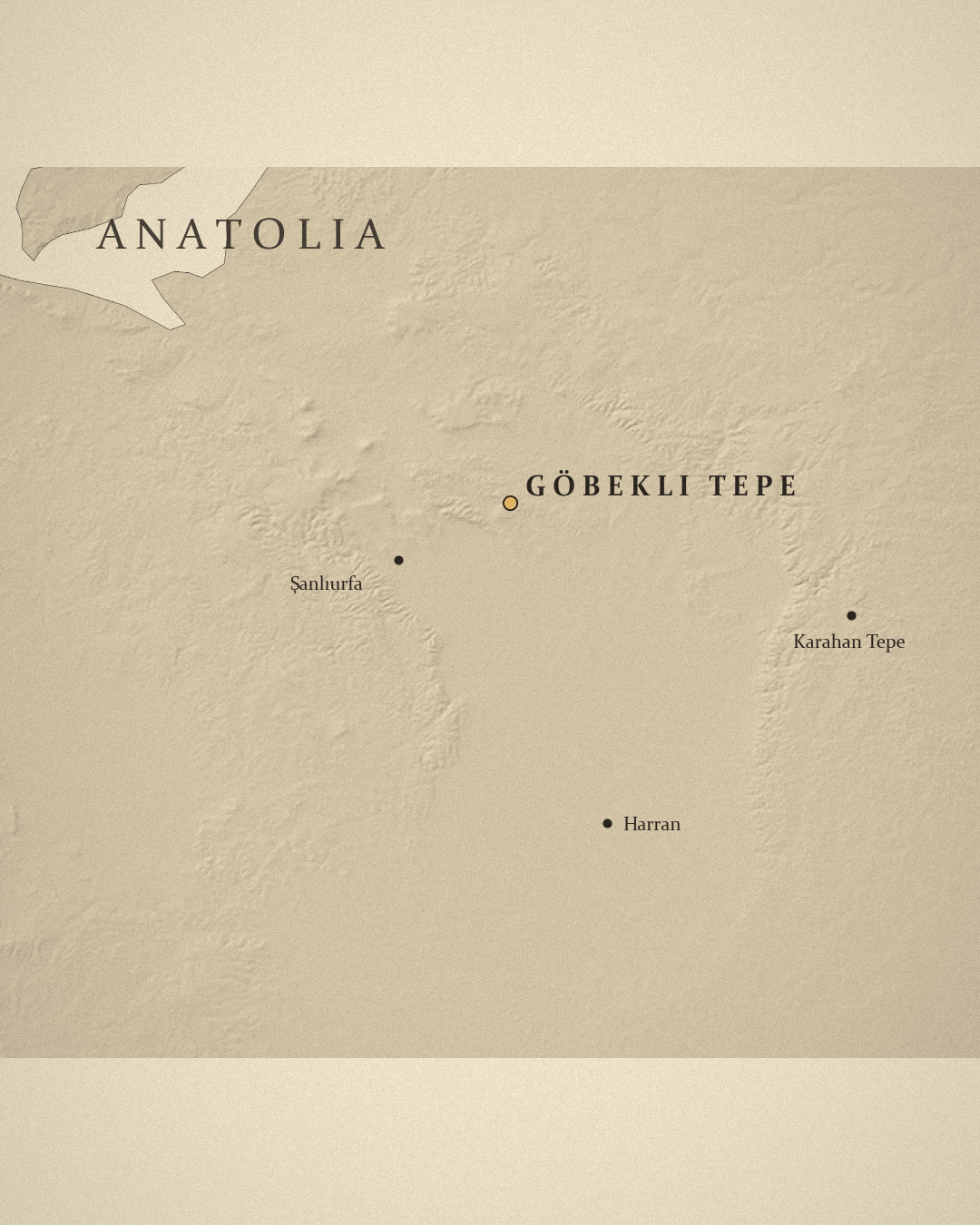
Göbekli Tepe, c. 9500 BC: the oldest monumental architecture on earth, raised by people who never farmed. A day on the rope crew, the feast that paid for the stones, the 7,268 grinding tools, and the open question of what the pillars were for.
The wrong order
The story every schoolbook told ran in one direction. First people farmed. Farming fed villages, villages grew into towns, and towns, once they had surplus and priests, raised temples. Göbekli Tepe stands in the wrong place in that sequence. The mound sits on a limestone ridge at the northern edge of the Harran plain, near the modern city of Şanlıurfa in southeastern Turkey, and its builders were hunter-gatherers. The site was occupied from about 9500 to 8000 BC, in the Pre-Pottery Neolithic, before domesticated cereals or herded animals appear in its record. The great round enclosures, with their T-shaped limestone pillars standing up to several meters tall, belong to the earliest part of that span.
A joint Istanbul-Chicago survey team walked the mound in 1963 and moved on, reading the broken slabs on the surface as grave markers. The German archaeologist Klaus Schmidt climbed the hill in 1994, recognized the slabs as the tops of buried prehistoric pillars, and excavated there from 1995 until his death in 2014. What came out of the ground has been argued about ever since.
A day on the rope
The pillars were quarried from the limestone plateau beside the site, and some unfinished pieces still lie in the rock where the carvers left them. Everything moved by muscle. There were no wheels, no metal tools, and no draft animals anywhere on earth for thousands of years to come.
How much muscle is a live argument. Klaus Schmidt's published estimates put the big central pillars at around ten metric tons and imagined hundreds of adults on the ropes. Edward Banning found no measured basis for the repeated ten-ton figure, modeled several of the above-ground pillar portions at roughly 2.5 to 6.3 tons, and calculated that fewer than twenty adults could move all but the largest pillars on level, lubricated ground. Both numbers are models, not recovered crew rosters. The episode shows a small crew and lets the stone look heavy, which is the part nobody disputes.
The hill itself was dry. No spring is known near the mound, the nearest modern seasonal stream runs about 3 kilometers west, and rock-cut basins near the site might be Neolithic cisterns, though their date and function remain tentative. Every drink on that worksite was carried up by somebody.
The feast in the ground
The strongest evidence for how the work got done is food. A site-wide study published in 2019 counted 7,268 grinding tools at Göbekli Tepe, including almost 3,400 basalt handstones, cut from a basalt source about 2 kilometers away. Use-wear on a large share of the tools fits cereal processing, and phytoliths confirm cereals in every major occupation phase examined, though the evidence does not resolve wild grain from domesticated. This is not household-scale equipment. The excavators read it as provisioning for crowds, and call the model work feasting: communal food, produced in quantity, is what assembled and held the labor that moved the stones.
Six limestone troughs and barrel-shaped vessels, the largest holding about 160 liters, produced the site's famous beer claim. A chemical spot test suggested oxalate, a residue consistent with fermented cereal, and the excavators offered it as preliminary support for brewing. A later critique stressed that the test would not reliably reproduce. Porridge or beer, the honest answer is that the evidence allows both. Either way, the people who pulled the ropes were fed, in quantity, at the site.
Temple, houses, or both
Schmidt called Göbekli Tepe the world's first temple, a mountain sanctuary that mobile hunter-gatherer bands visited but did not inhabit. Edward Banning answered in 2011 that the sharp line between temple and house is a modern habit, and that the enclosures could have been dwellings rich in symbols. The current excavation account has outgrown both slogans. Recent work has found round and oval buildings, probably from the earliest phase, packed beside hearths and bead-making debris, and later rectangular buildings with burials beneath the floors, alongside buildings with some special social function. People lived on this hill. The clean story of a pure temple visited by pilgrims is gone, and the older two-layer version of the site's history went with it.
What did not go is the strangeness. The carved pillars, the foxes and snakes and boars and cranes in relief, the buried and refilled enclosures, none of it reads as ordinary living furniture, and none of it can be read at all in the way a text can. Writing would not exist anywhere for another six thousand years. When the first tablets were pressed in Mesopotamia, these pillars were already older than the pyramids are today.
What were the stones for
Nobody knows. That is not a rhetorical flourish, it is the state of the field. The narration's closing idea, that scattered families needed an appointment big enough that nobody stayed home, and that the stone was the appointment, is a guess, and the episode marks it as one on screen. It sits inside a real scholarly corridor: the feasting evidence shows large gatherings, and archaeologists have long argued that monuments of this scale can create the very communities that build them. But motive is not something a trowel recovers. The carvings keep their meaning, the enclosures keep their purpose, and the field keeps digging. Less than a tenth of the mound has been excavated.
The reconstruction in this episode follows the published evidence where it exists: the quarry, the ropes as a marked reconstruction, the grinding stones, the feast. Where the record is silent, the picture stays deliberately ordinary, a work crew, a meal, a new man on the back rope. The overhead excavation photograph, the Israel Museum grinding equipment, and the carved pillar photograph in the episode are real archaeology, credited on screen.
Sources
- Laura Dietrich et al., 'Cereal processing at Early Neolithic Göbekli Tepe, southeastern Turkey' (PLOS ONE, 2019): the site-wide grinding-equipment study; 7,268 grinding tools, ~3,400 basalt handstones, use-wear and phytolith evidence, and the workforce-provisioning argument.
- Oliver Dietrich, Manfred Heun, Jens Notroff, Klaus Schmidt and Martin Zarnkow, 'The role of cult and feasting in the emergence of Neolithic communities' (Antiquity, 2012): the work-feasting model, the six large limestone troughs with capacities up to about 160 litres, and the preliminary oxalate evidence.
- E. B. Banning, 'So Fair a House: Göbekli Tepe and the Identification of Temples in the Pre-Pottery Neolithic of the Near East' (Current Anthropology, 2011): the case that the enclosures may have been dwellings rich in symbolism, the critique of the 10-ton pillar estimates, and the small-crew transport argument.
- E. B. Banning (Open Archaeology, 2023): friction modelling of T-pillar transport at Göbekli Tepe; fewer than twenty adults could move all but the largest modeled pillars on level, lubricated ground.
- Lee Clare, 'Göbekli Tepe, Turkey. A brief summary of research at a new World Heritage Site (2015-2019)' (e-Forschungsberichte des DAI, 2020): the current excavation account; occupation c. 9500-8000 BC, probable PPNA round-oval domestic buildings, Early PPNB rectangular buildings with subfloor burials, and the revised reading of the old two-layer scheme.
- Oliver E. Craig (Current Anthropology, 2021): critique of the fermented-beverage residue evidence, including the reproducibility of the oxalate spot test.
- Laura Dietrich et al., 'Investigating the function of Pre-Pottery Neolithic stone troughs from Göbekli Tepe' (Journal of Archaeological Science: Reports, 2020): experimental work on cereal foods and the troughs.
Tell us in the comments — the next episode is picked from what you ask for.
Subscribe on YouTube Watch the seriesMore from the series
The Weapon Was Not the Blade

The Warrior in the Courthouse Line