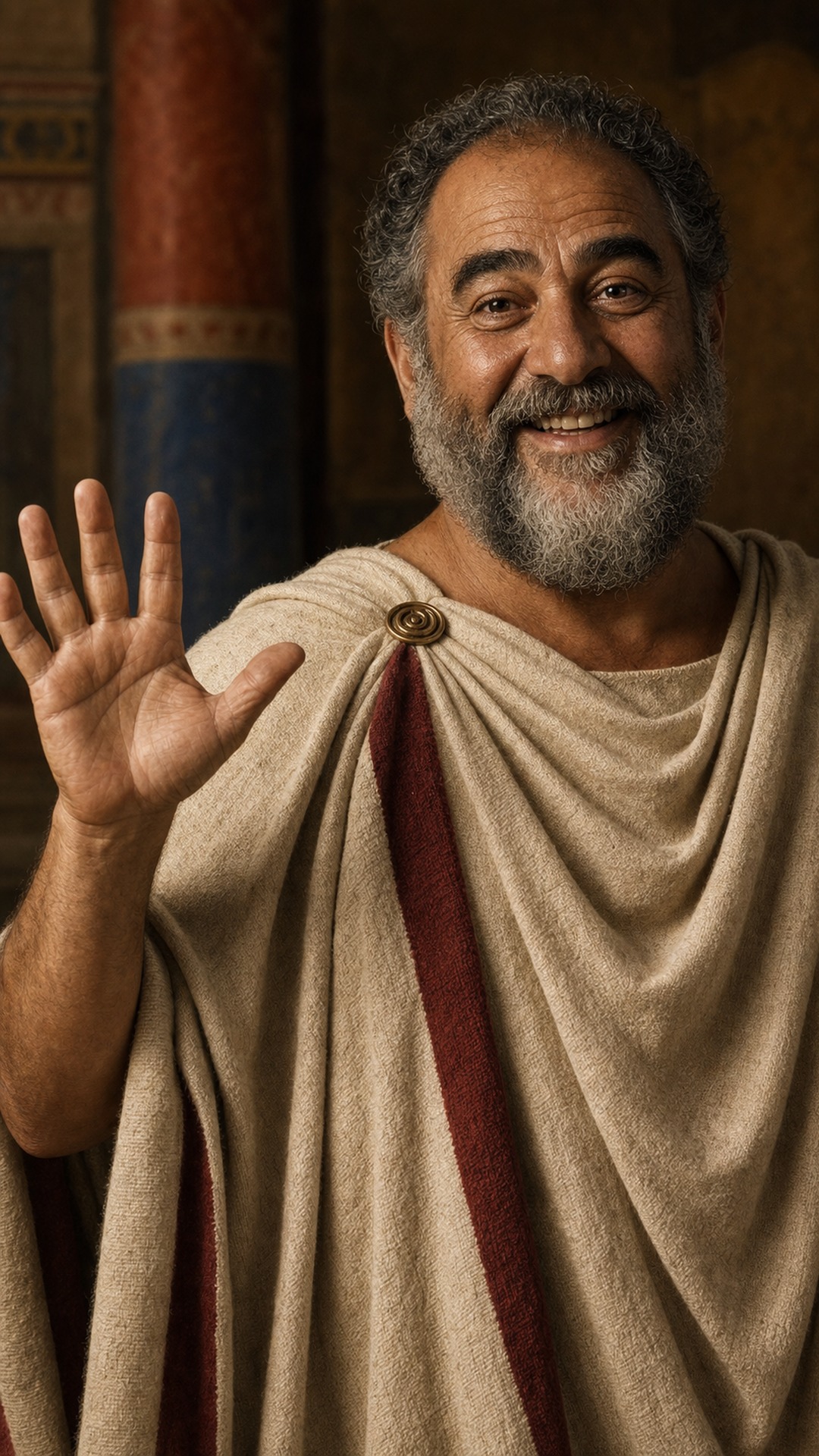
The Weapon Was Not the Blade
- Civilization
- Japan
- Occupation
- Jinin. A shrine-affiliated Kyoto sake brewer, carrier in the Mountain's protest
- Material
- The god & the ledger
- Period
- c. 1169 AD
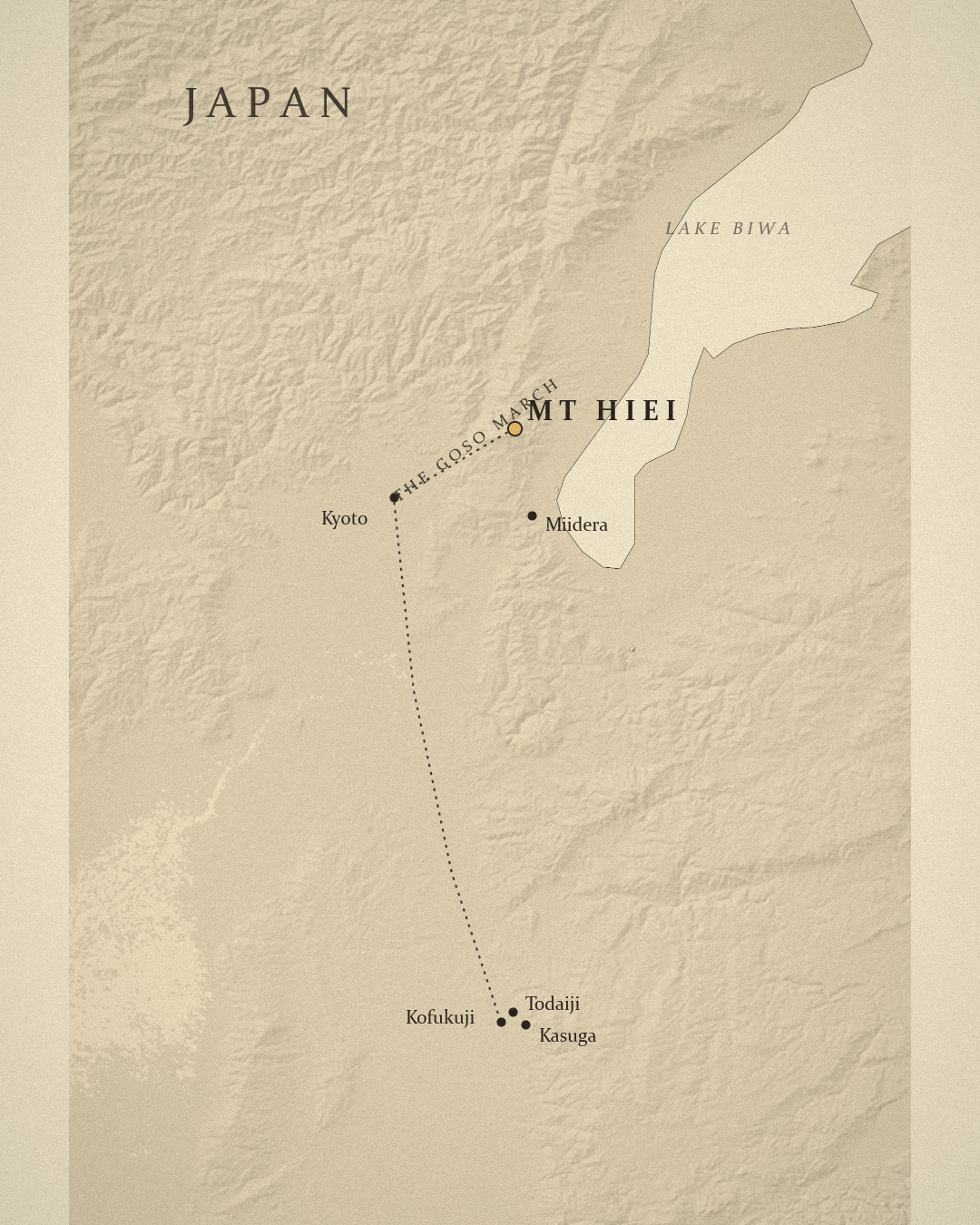
The 'warrior monks' of Heian Japan are largely a myth. The word sohei wasn't coined until 1715. What existed on Mount Hiei was a temple-shrine network that fought with lawsuits, ritual strikes, and a sacred palanquin no soldier could safely shoot. The winter-1169 march on Kyoto, seen from inside the crowd.
The winter of 1169
In the winter of 1169, late in the Heian period, an estate dispute in the provinces brought the great temple of Enryakuji down off Mount Hiei and into the capital. An appeal was filed. Six days later, eight sacred palanquins, mikoshi, had gathered at Kyogokuji, and six of them stood at the gates of the imperial palace. The court ordered Taira no Shigemori, one of its leading commanders, to clear them away. He was ordered three times, and three times he declined. (These are Japanese lunar-calendar dates, recorded in the courtier diaries Heihanki and Gyokuyo; the events run from the twelfth month of 1169 into the new year.)
A visitor to Kyoto that winter, hunting for the famous warrior monks of the mountain, would have gone home disappointed. The crowd at the gates was not an army of monster-monks with giant blades. It was, in large part, the Mountain's own townsmen: the brewers, lenders and toll-keepers who lived under the shrine's protection and owed it service on the day it called. The most feared force in Japan turned out, on close inspection, to be a protest, a lawsuit, and a god.
The businessmen inside a sacred franchise
The Mountain's power was not, first of all, a matter of swords. Enryakuji sat at the head of a network: the three precincts on Hiei, the Hie shrine complex at its foot, the towns and landing-places along Lake Biwa, branch temples, estates, and patrons at court. Woven through it were the jinin: people under a shrine's authority and protection. A jinin might be a trader, a brewer, a moneylender, an artisan, a transporter, a village headman or a local strongman. The shrine gave him jurisdictional and fiscal cover, a seal that kept tax-collectors and rivals at arm's length. In return he owed dues, goods, ritual service and, when the Mountain mobilised, his shoulder under a palanquin pole.
This is why a temple crowd could be counted as clergy and still be full of laymen. In 1113 the courtier Fujiwara Munetada watched a crowd of perhaps four to five hundred people gather in the capital and called them Enryakuji daishu, the temple's 'assembly', yet his own diary notes that Hie shrine affiliates were among them. The figure measures a mobilised coalition, not a muster of warrior-monks. The Mountain's deepest reserves were economic: it lent grain, held tolls, and stood behind much of the capital's commerce. The court could fight monks. It could not easily fight the people who fed the city, moved its goods, and poured its sake, all at once.
The petition, and the law written against it
The Mountain's coercion ran up a ladder, and the bottom rung was paper. Temples were the most patient litigants in Japan: they kept every deed, every boundary marker, every letter of appointment, sometimes for centuries, and they sued. A dispute began with a petition, filed properly and filed politely, and everyone in the capital understood that the petition was not yet the threat. It was the record: proof, for later, that the temple had asked first.
How routine this had become is visible in the law written to stop it. In 1231, some sixty years after the 1169 march, the Kamakura warrior government issued Supplemental Law 33, which forbade religious institutions from carrying a sacred palanquin onto land that was not theirs, from declaring houses and goods sacred property, and from collecting debts behind a holy object. Seizing goods on the road was to be treated as robbery. Legislators do not draft a statute against a practice that is not happening. It was this supplemental law, not the better-known Goseibai Shikimoku of 1232, that struck directly at sacred-object coercion.
The silent god, and the walking tree
Above the petition sat the strike. A temple could make its god fall silent. It suspended the festivals, the blessings, and the prayers offered for the emperor's health and the harvest. Then it left the god's own vehicle somewhere costly: in a road, at a bridge, before a great man's gate. The object could not simply be shifted, for to handle it wrongly was sacrilege, and it could not be ignored, because it was a god sitting in the street. Normal court and religious business froze until the grievance was settled. In 1173, four years after the 1169 march, the sacred tree of Kasuga was carried to the regent's own residence at Uji and left there while a quarrel over toll barriers burned on. No weapon drawn, and the machinery of government simply stopped.
That tree belonged to the other great complex, Kofukuji and its Kasuga shrine in Nara, whose god travelled as a mirror-hung branch of the sacred sakaki. Its most famous outing came in 1093. A governor named Takashina Tameie had seized estate land the temple claimed. Kofukuji mobilised and, by the count preserved in the courtier diaries, entered Kyoto twenty days later. That same night the court removed Tameie and sent him into exile, although the temple had never produced clear title to the land. It did not have to. The tree was in the city. (The completed 1093 march is securely documented; the picture of a fully developed sacred-tree procession owes something to later ritual histories.)
The god in the streets
The highest rung that still used an object was the mikoshi itself, the palanquin of the mountain god, carried down into the capital. To the people kneeling along the route this was not a symbol of the deity. The god was understood to be inside it. That is what made it a weapon. A soldier at the gate faced a calculation every commander dreaded. An arrow that struck a carrier made a martyr. An arrow that struck the palanquin made the archer a man who had shot a god, and left him, not the protesters, as the party the court would have to punish.
It is often said that soldiers 'could not' shoot at the sacred vehicles. Taken literally, that is wrong: they did shoot. The constraint was legal, political and religious, not physical. In 1118 the court had explicitly ordered its defenders not to fire on the clergy, an order that records a policy, not an impossibility. And the outcomes were never automatic. In 1147, twenty-two years before the 1169 march, Taira retainers loosed arrows at the Gion palanquins, and the court temporarily suspended the two commanders held responsible, the head of the Taira house among them. Yet in 1123, when Hie palanquins came down and men died in the fighting, the responsible commander went unpunished and the court simply paid to repair the damaged vehicles. Striking a mikoshi could ruin you. It did not have to.
This is the arithmetic behind Taira no Shigemori's three refusals in 1169. Ordered to clear the palanquins from the palace gates, the general declined, and not from cowardice. The Mountain's true threat was never an army in the field. It was a plaintiff who could not be killed, walking toward the court with a lawsuit no one could win.
The warrior monk who was invented later
And the army itself? Search the surviving records for the warrior monk of legend, the white cowl, the robe over armour, the tall wooden clogs, the man-high curved blade, and he is remarkably hard to find in the period. The very word for him, sohei, 'monk-soldier', is not medieval at all: its first known Japanese use is in an antiquarian work of 1715, more than five centuries after the 1169 march. The familiar uniform is a later synthesis, hardened in Edo-period prints and in the theatre around legendary figures such as Benkei, whose cowl, clogs and giant glaive take their fixed form only from the fifteenth century onward. Even the naginata, the glaive that supposedly defined the type, is not attested as a weapon until the middle or later twelfth century, and it was carried by lay and monastic foot-soldiers alike.
The numbers tell the same story. A biography of the abbot Ryogen, completed in 1031, records that around the year 980 some 2,700 monks were enrolled on the mountain, and that when an assembly was called to count heads, about 2,000 attended. Both figures are preserved in a partisan, miracle-laden life in which registration is not residence and neither total counts a single fighter. The celebrated 'three thousand' of Mount Hiei was a corporate epithet and a round number, not a census of soldiers. When a document does list actual people owing service, the composition is startling: a toll dispute of 1315, tied to Todaiji, names ninety-two participants, twenty of them monks and seventy-two laymen. It is one dispute's roster, not a universal ratio, but it points where all the evidence points. The temple's real standing army was a book of loans.
What actually turned out for a great temple was a mixed coalition: hall workers and administrators, the personal retainers of noble monks, shrine affiliates like our brewer, warriors summoned from estates, and, genuinely but as a minority, some ordained monks who bore arms. 'An army of warrior-priests' inverts the balance of the evidence. Nor were these houses locked in permanent holy war. In 1163, six years before the march, Enryakuji burned the rival Tendai temple of Onjoji (Mii-dera) across Lake Biwa, the fourth in a traditionally numbered series of destructions. Yet the same rivals shared patrons, litigated in the same court, and cooperated when it suited them. (Six of the numbered burnings fall before 1300 and a seventh in 1319. The fighting was real; the total war is a later simplification.)
Three things beyond an emperor's control
Two centuries after these events, Kyoto was still repeating a line about the retired emperor Shirakawa, by most measures the most powerful man of his age. Three things, the story went, refused to obey him: the water of the Kamo river, the fall of the dice, and the monks of the Mountain. He may never have said it. The saying survives only in war tales, the Heike monogatari and the Genpei Josuiki, written long after Shirakawa's death in 1129, and both mark it as hearsay, something 'handed down' rather than heard. (It belongs to Shirakawa, not to his grandson Go-Shirakawa, who reigned as retired emperor in 1169; and the 'monks of the mountain' are specifically the clergy of Hiei, not the wandering ascetics the phrase later came to suggest.) But the city that kept repeating the line was in a position to know.
The 1169 march itself ended the way these confrontations usually ended: in slow bargaining. The night the palanquins reached the gates, the court exiled the man at the centre of the dispute. Within days the order was reversed. So the Mountain pressed again, and about six weeks later won the exile a second time. A goso was iterative pressure over the administration of land and revenue, not a charge to be won at a stroke. Its practitioners did not need to win quickly. They needed only never to stop.
The great blades of the warrior monks now sit in museum cases, polished for an order that mostly never existed. What actually held the court in check has no display: a network of deeds and debts, tolls and dues, and a god that could be carried, at the right moment, straight into the middle of the capital. The legend kept the armour. The institution kept the receipts.
Sources
- Mikael S. Adolphson, The Gates of Power: Monks, Courtiers, and Warriors in Premodern Japan (University of Hawai'i Press, 2000): core analysis of the 1093, 1123, 1147, 1169 and 1173 incidents, the goso repertoire, and the reliability of the Shirakawa saying (pp. 2–3, 100–05, 145–54, 240–69). The 1169 Narichika march (the appeal, the eight mikoshi at Kyogokuji and six at the palace gates, and Shigemori's three refusals) is drawn from the contemporary courtier diaries Heihanki and Gyokuyo, Kao 1/12, analysed at pp. 149–51.
- Mikael S. Adolphson, The Teeth and Claws of the Buddha: Monastic Warriors and Sohei in Japanese History (University of Hawai'i Press, 2007): the case against a stable 'sohei' type: the 1715 first attestation, the later-synthesized uniform and naginata chronology, the mixed-coalition finding, and the 1315 duty list (pp. 8–9, 57–61, 80–81, 118–53, 145–47).
- Paul Groner, Ryogen and Mount Hiei: Japanese Tendai in the Tenth Century (University of Hawai'i Press, 2002): the c. 980 register (2,700 enrolled / 2,000 attending) and the scale of the Hiei community (pp. 2, 237–44).
- Mikael S. Adolphson, 'Discourses on Religious Violence in Premodern Japan', Religions 9.5 (2018), article 149: open-access synthesis on the medieval vocabulary (daishu, doshu, akuso, jinin) and Ryogen's 970 regulations.
- Neil McMullin, Japanese Journal of Religious Studies (Nanzan, 1987): the jinin: shrine affiliates (traders, brewers, transporters, local strongmen) bound to a temple-shrine network by reciprocal protection and service.
- Suzanne Gay, The Moneylenders of Late Medieval Kyoto (University of Hawai'i Press, 2001), pp. 61–80: the moneylending and brewing affiliates in the Enryakuji/Hie orbit (late-medieval evidence; cited here for the structure of the affiliate economy, not for a 1169 headcount).
- Hirofumi Katahira, 'On the Enryakuji goso in the reign of Emperor Shirakawa', Ritsumeikan chirigaku 25 (2013), pp. 53–64: the Shirakawa-period goso chronology and a source-comparison of the 'three things' saying.
- Christoffer R. Bovbjerg, The United State in Kamakura Law (PhD diss., University of California, Berkeley, 2018), pp. 81–82: Kamakura Supplemental Law (tsuika-ho) 33 of 1231 against mikoshi coercion, and the hearsay status of the Shirakawa saying.
- National Diet Library Collaborative Reference Database: source survey for the Shirakawa 'three things' quotation, tracing its appearance in the Heike monogatari ('Gandate') and Genpei Josuiki with their explicit hearsay language.
- Tengu zoshi emaki, Toji–Daigoji scroll, 1296: Tokyo National Museum / ColBase, CC BY; a contemporary picture scroll satirising proud monastic personnel, the closest period 'voice' on the mountain's people.
Tell us in the comments — the next episode is picked from what you ask for.
Subscribe on YouTube Watch the seriesMore from the series
The Warrior in the Courthouse Line
The Lender Who Bet Against the Sea