
The Palace Fell. The Payroll Survived.
- Civilization
- Persia
- Occupation
- Ration scribe, at the pay window of the Achaemenid administration
- Material
- Clay & grain
- Period
- c. 500 BC
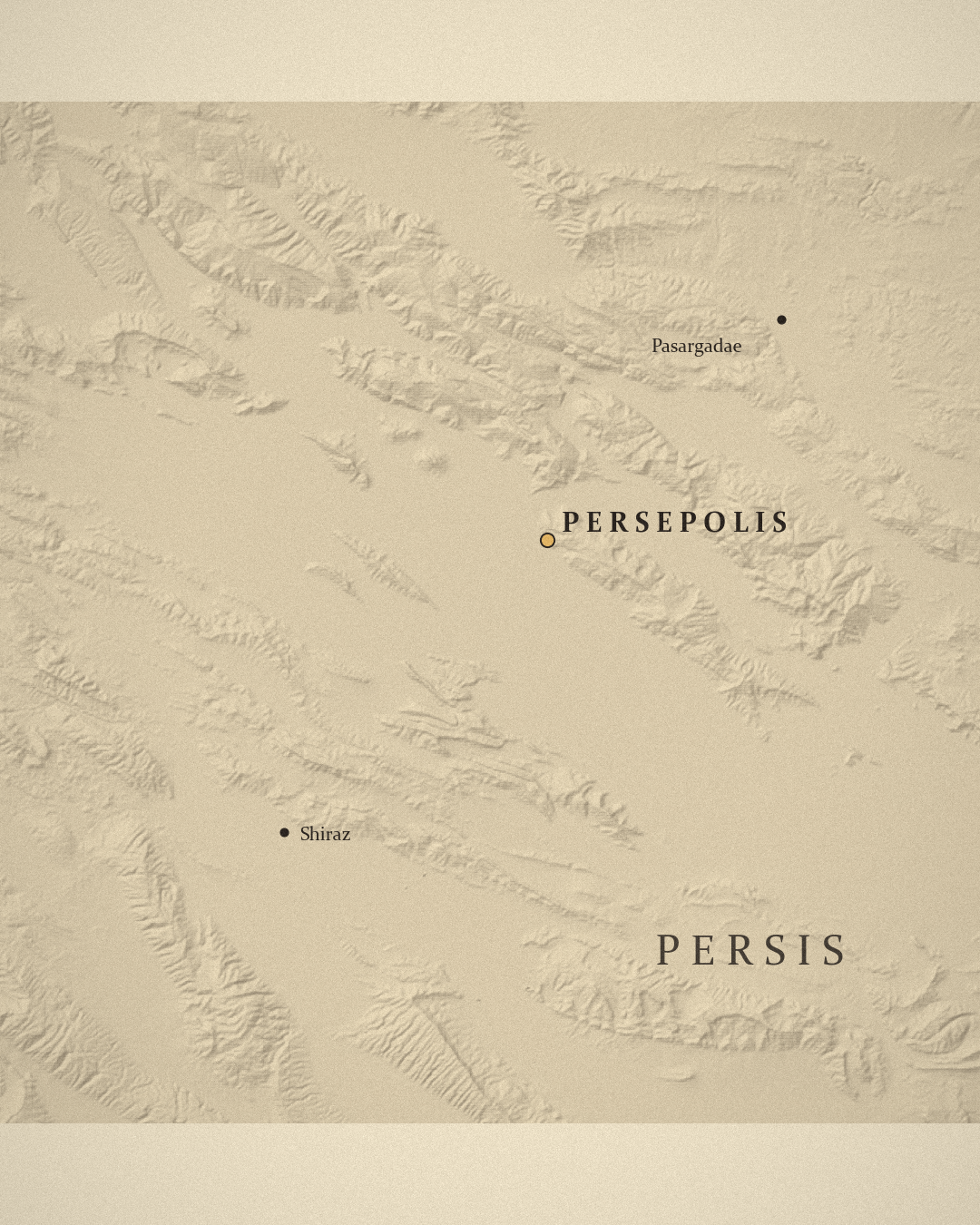
Persepolis, ancient Persia, c. 500 BC: payday in the Achaemenid Empire, recorded on clay. The ration rates, the weaver chief who out-drew the men in her line, Haradkama's sheep-and-wine paycheck, the doubled birth bonus, and the wine ledger that never balanced.
The empire that wrote everything down
Persepolis was the ceremonial palace city of the Achaemenid Persian Empire, begun under Darius I on a terrace at the foot of a mountain in Persis, in what is now Fars province, Iran. Two excavated archives of clay tablets survive from its administration. The Fortification archive, found in the 1930s in the collapsed fortification at the edge of the terrace, records the movement and payment of food in Elamite cuneiform, concentrated in the years around 509 to 493 BC. The Treasury archive, from the treasury building, values work in silver and runs later, into the reign of Artaxerxes I. Tens of thousands of tablets and fragments survive; Richard Hallock's 1969 edition alone published 2,087 Fortification texts, and the two offices are now read as overlapping parts of one system rather than a sequence of reforms.
The texts are terse. They record who was issued what commodity, at what rate, for what period, under whose seal. Modern words like payroll and wage are shorthand for something more alien and more interesting: a continental administration that paid in entitlements, substitutions, and official valuations, and wrote all of it down. The episode's scribe is a reconstruction. His ledger is not.
Three measures for a man
The cleanest base-rate tablet is PF 850. One month, one workforce: Turpis supplies 107 BAR of grain for 50 Cappadocian workers. Nineteen men receive 3 BAR each, nineteen women 2 BAR, six boys and six girls 1 BAR each. The arithmetic balances exactly. A BAR is about ten ancient quarts, a bit over nine liters, so the ordinary man's month of grain is roughly 28 liters and the ordinary woman's about 19.
That 3-and-2 baseline recurs across the regular ration series, but it was a floor with a ladder above it. Skilled and titled grades drew 3.5, 4, or 6 BAR. Boys and girls were graded in five steps. One unexplained official named Manukka drew 12, double the ordinary top grade, and Hallock could not say why. Two honest caveats travel with all of these numbers: a recorded issue is not proof of a worker's whole income or whole diet, and the categories the scribes used, including boy and girl, are administrative grades rather than counted birthdays.
The chief draws five
In PF 865 and PF 866, the woman chief of a large mixed workforce receives 5 BAR of grain a month. That is more than the ordinary male rate, more than the skilled 4-BAR grades in her own account, and in those tablets more than every man except one. Parallel texts give women chiefs 3 marris of wine a month, and a bulk order assigns named women chiefs sheep on a schedule that averages a third of a sheep per month. The records rule out the simple story that every woman earned less than every man. They also stop short of proving a general equal-pay rule, because the texts rarely let us hold job, place, and date constant at once.
The tablets call her workforce pasab. What pasab work actually was has been argued for decades. Older scholarship guessed at tailoring or carpet work without a secure basis. A 2025 study by Yazdan Safaee reads the groups as textile workers, probably weavers, partly on the strength of a newly recognized Aramaic note on one tablet. The episode follows that reading and shows a weaving floor. It is a current scholarly argument, not a word the tablets translate for us.
Sheep, wine, and silver
The Treasury archive measures work in silver. PT 1 is the tablet behind the episode's Egyptian woodworker: Haradkama, titled chief-of-hundred, owed six and a half shekels a month for five months of work at Persepolis. The account settles his 32.5 shekels not in coin but in commodities at fixed official rates, sheep counted at three shekels each, a measure of wine at one. A graded schedule in PT 24 pays 28 relief-carvers between half a shekel and one and a half per month, which makes Haradkama's rate four to thirteen times his neighbors' and shows how wide the documented spread runs.
Ordinary pay stayed mostly in grain, but beer and wine sit in the regular worker schedules and special issues, and fruit and small livestock enter worker accounts too. None of this worked like a cash envelope plus groceries. The administration recorded entitlements and discharged them in whatever the local stores held, at values the accountants fixed. How a worker spent an issue, the tablets almost never say.
The ledger that would not balance
The archive's strangest corner is the birth issues. Hallock grouped dozens of texts recording one-time payments to women who had recently given birth. The stable feature is a two-to-one differential: a mother recorded with a boy receives twice the issue of a mother recorded with a girl, in grain and in drink alike. PF 1224 is the episode's example, 32 BAR of grain to 23 Ionian women at Persepolis, 2 BAR for each mother of a boy, 1 for each mother of a girl. The tablets record the child's sex as an accounting trigger and never state a reason. Hallock guessed the empire was rewarding future workers. The scribes wrote numbers, not motives.
Travel ran on the same paperwork. A traveler on state business carried a sealed authorization, the halmi, and drew flour at stations spaced roughly a day apart, one day's ration at a time. No document, no flour. And the accounting was human. PF 875, a wine account, carries a header that says 26 marris while its own line items add to 27. The discrepancy sits uncorrected on the clay, twenty-five centuries later.
Alexander took Persepolis in 330 BC and the palace burned. The archives survived in the ruins, were excavated in the 1930s, and are still being read, joined, and argued over. The episode's closing line is literal. The payroll outlived the empire that issued it, and it still does not quite add up.
Sources
- Richard T. Hallock, Persepolis Fortification Tablets (OIP 92, University of Chicago, 1969): the edition behind PF 850, PF 865-866, PF 875, and the birth-issue group; the base rates, graded scales, liquid schedules, and metrology.
- George G. Cameron, Persepolis Treasury Tablets (OIP 65, University of Chicago, 1948): the Treasury archive edition; PT 1 (Haradkama's sheep-and-wine settlement) and PT 24 (the graded relief-carvers' schedule).
- Annalisa Azzoni, Matthew W. Stolper and others, 'Persepolis Administrative Archives' (Encyclopaedia Iranica, 2017): the archive-level overview; discovery, scale, languages, and date ranges of the Fortification and Treasury corpora.
- Wouter F. M. Henkelman and Matthew W. Stolper, 'Ethnic identity and ethnic labelling at Persepolis' (2009): worker groups, ethnonyms, and the reading of ration categories.
- Wouter F. M. Henkelman, Kai Kaniuth and Kourosh Mohammadkhani, 'Resilience at Persepolis' (2023): the overlap of the Fortification and Treasury offices and the linked Babylonian stonecutter workforce paid in both grain and silver.
- Yazdan Safaee, 'Persian Female Weavers in the Persepolis Economy' (2025): the current argument that the pasab workforces were textile workers, probably weavers.
- Maria Brosius, 'Women i. In Pre-Islamic Persia' (Encyclopaedia Iranica, 2000): women in the Persepolis workforce records, female chiefs, and the reconstructed supervisory package.
- Mark Tamerus, 'Elusive silver in the Achaemenid heartland' (2016): silver as accounting value versus metal in hand in the Fortification and Treasury archives.
Tell us in the comments — the next episode is picked from what you ask for.
Subscribe on YouTube Watch the seriesMore from the series

The Stone Was the Appointment

The Weapon Was Not the Blade