
The Men Who Scraped an Empire's Water Clean
- Civilization
- Rome
- Occupation
- Aquarius (aqueduct maintenance man)
- Material
- Limestone, waterproof plaster, iron
- Period
- c. AD 97
Frontinus — the senator Nerva appointed to run Rome's water in AD 97 — left a working manual of the aqueduct service: two permanent maintenance crews totalling around seven hundred men, next-day work orders, and standing rules for taking a channel out of service. Inside the channels, the enemy was a mineral crust the water itself deposited, hardening until it choked the flow.
A machine that grows its own blockage
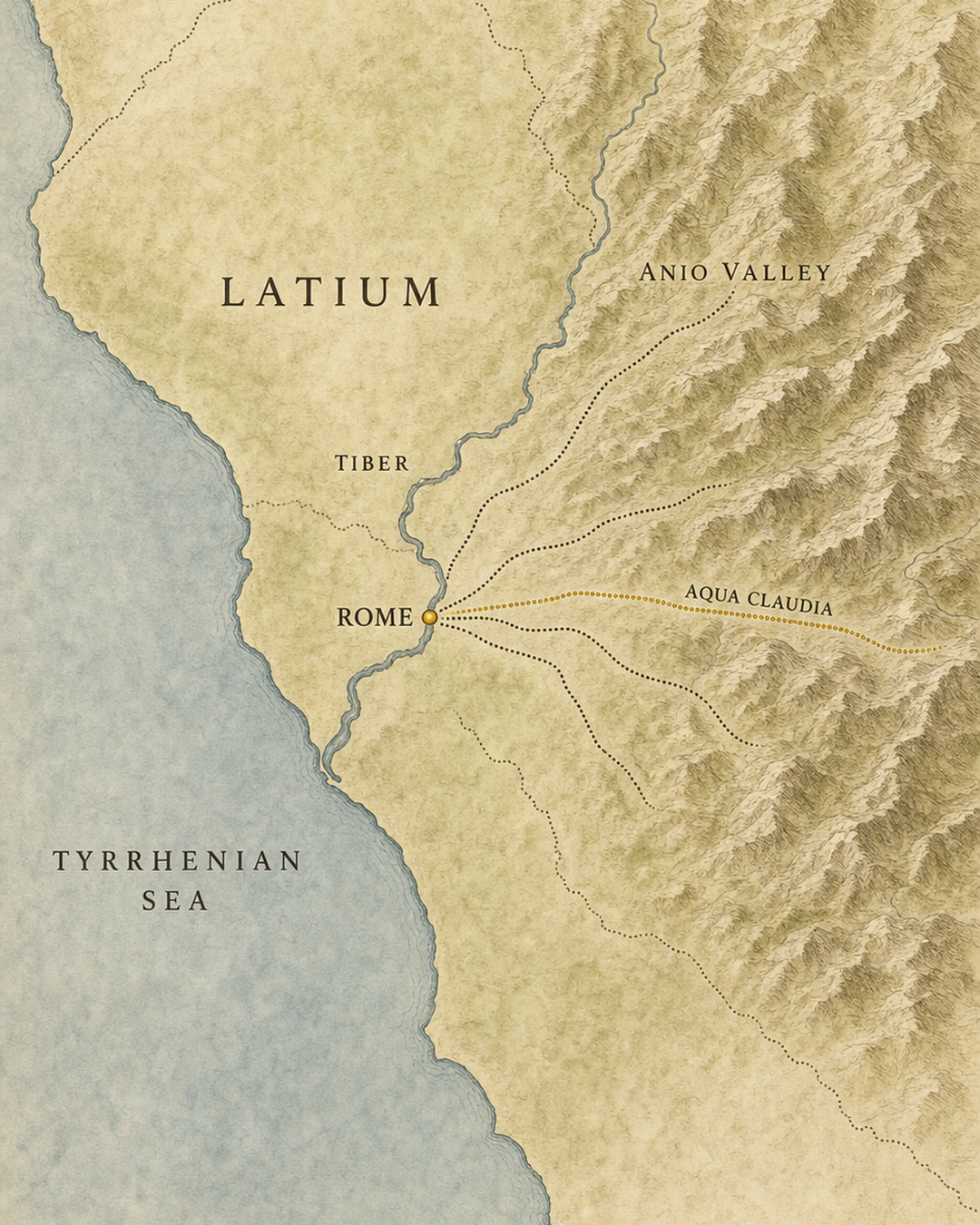
By the end of the first century AD, nine aqueducts fed Rome, the longest — the Marcia — running roughly ninety-one kilometers from the springs of the Anio valley. Most of that length was underground channel, engineered to a fall gentle enough that water walked, rather than fell, into the city. The system had no pumps and no valves that could save it from itself: whatever the water carried, the channel kept.
Rome's spring water was hard. As it degassed in the open channel it precipitated calcium carbonate onto the walls and floor — the same chemistry that furs a kettle or a showerhead, at civic scale. Frontinus, the water commissioner, described the result plainly: deposits that harden at times into a crust, and narrow the passage of the water.
The commissioner's manual
We know the maintenance system because its administrator wrote it down. Sextus Julius Frontinus — consul, general, and from AD 97 curator aquarum under Nerva — composed De aquaeductu, a working handbook of Rome's water service, and it survives entire.
Frontinus inherited two standing crews: the familia publica, about two hundred and forty men, dating back to Agrippa, and the familia Caesaris, four hundred and sixty men, created by Claudius when he brought the Claudia and the Anio Novus into the city — roughly seven hundred in all, organized under foremen into inspectors, tank-keepers, stone workers, plasterers and other craftsmen. His management tools were recognizably modern: a work order prepared the day before, and a daily record of work completed.
The nine aqueducts of Rome
By AD 97 the nine aqueducts of Rome were the Appia, the Anio Vetus, the Marcia, the Tepula, the Julia, the Virgo, the Alsietina, the Claudia and the Anio Novus. Frontinus opens De aquaeductu by naming all nine, with the builder and the date of each. Every channel on the list grew the same carbonate crust, and the crews of this episode served them all.
Never in summer
For work inside the channel — the crust, the failing waterproof lining — the water had to be turned off. Frontinus's rules for that shutdown read like a utility's maintenance notice two millennia early: never in summer, when the city's demand peaked; schedule for spring or autumn; prepare everything in advance and work at maximum speed; and take down one aqueduct at a time, so Rome never lost its supply.
The episode stages exactly this moment: an autumn shutdown, a dry channel, and a man working fast against the city's thirst.
The crust remembers the crews
The scraping itself left almost no trace in the texts — but it survives in the stone. At the Divona aqueduct in Gaul, researchers reading the carbonate layers found the maintenance crews' fingerprints: growth bands truncated mid-sequence, centimeter-scale tool marks, broken carbonate rubble, and dust films laid down while the channel stood empty. The intervals between cleanings ran from one to five years, and of the interventions they could date by season, not one fell in summer — Frontinus's rule, obeyed in a province far from Rome.
In Rome's own Anio Novus, the deposits that were never scraped away still lie up to about twenty-six centimeters thick on the channel floor, and hydraulic reconstruction suggests the crust could cost an aqueduct up to about forty percent of its capacity. The maintenance was not cosmetic. It was the difference between a working aqueduct and a stone pipe slowly sealing itself shut.
The men called aquarii
Who did the scraping? Frontinus never names the trade — his lists give foremen, inspectors, tank-keepers, stone workers, plasterers. But the water service's own men appear on their tombstones under a broader title: aquarius, water-man. One epitaph names Laetus, a public slave of the Roman people, aquarius of the Anio Vetus at a delivery tank on the Via Latina. The title covered the service, not the specific misery of the channel; the man with the scraper worked somewhere inside it, unnamed.
What the record does preserve is the stakes. The inscription on Rome's Porta Maggiore records Vespasian restoring the Aqua Claudia after nine years out of service — an official claim on a triumphal gate, but a number an emperor thought worth carving in stone. When the maintenance stopped, the water stopped. Rome's greatest machine was never the arches; it was the men who kept them clean.
Sources
- Frontinus, De aquaeductu urbis Romae, Book I (R. H. Rodgers translation)
- Frontinus, De aquaeductu urbis Romae, Book II — the familiae (116–118), work rules (117), channel deposits and the shutdown rules (121–123)
- Sürmelihindi et al., 'Roman aqueduct maintenance in the water supply system of Divona, France', Scientific Reports 13 (2023) — the tool marks, cleaning intervals and seasonality
- Keenan-Jones et al., 'Travertine-based estimates of the amount of water supplied by ancient Rome's Anio Novus aqueduct', Journal of Archaeological Science: Reports 3 (2015) — the surviving carbonate thickness
- Motta et al., 'Hydraulic Evaluation of the Design and Operation of Ancient Rome's Anio Novus Aqueduct', Archaeometry (2017) — modeled capacity loss from travertine
- CIL VI 1257 — the Porta Maggiore inscription of Vespasian (Latin text and translation, R. Benefiel, University of Virginia)
- Luciani, 'Public Slaves in Rome: Privileged or Not?', Classical Quarterly 70.1 (2020) — Laetus, aquarius of the Anio Vetus (CIL VI 2345)
- O. F. Robinson, Ancient Rome: City Planning and Administration (Routledge, 1992) — the water administration and its personnel
Tell us in the comments — the next episode is picked from what you ask for.
Subscribe on YouTube Watch the seriesMore from the series

The Salt Hearts of Hallstatt

The Fire-Gilders of Kaupang