
The Lender Who Bet Against the Sea
- Civilization
- Greece
- Occupation
- Maritime lender — writer of bottomry loans (nautika daneia)
- Material
- Silver & sea-risk
- Period
- c. 350 BC
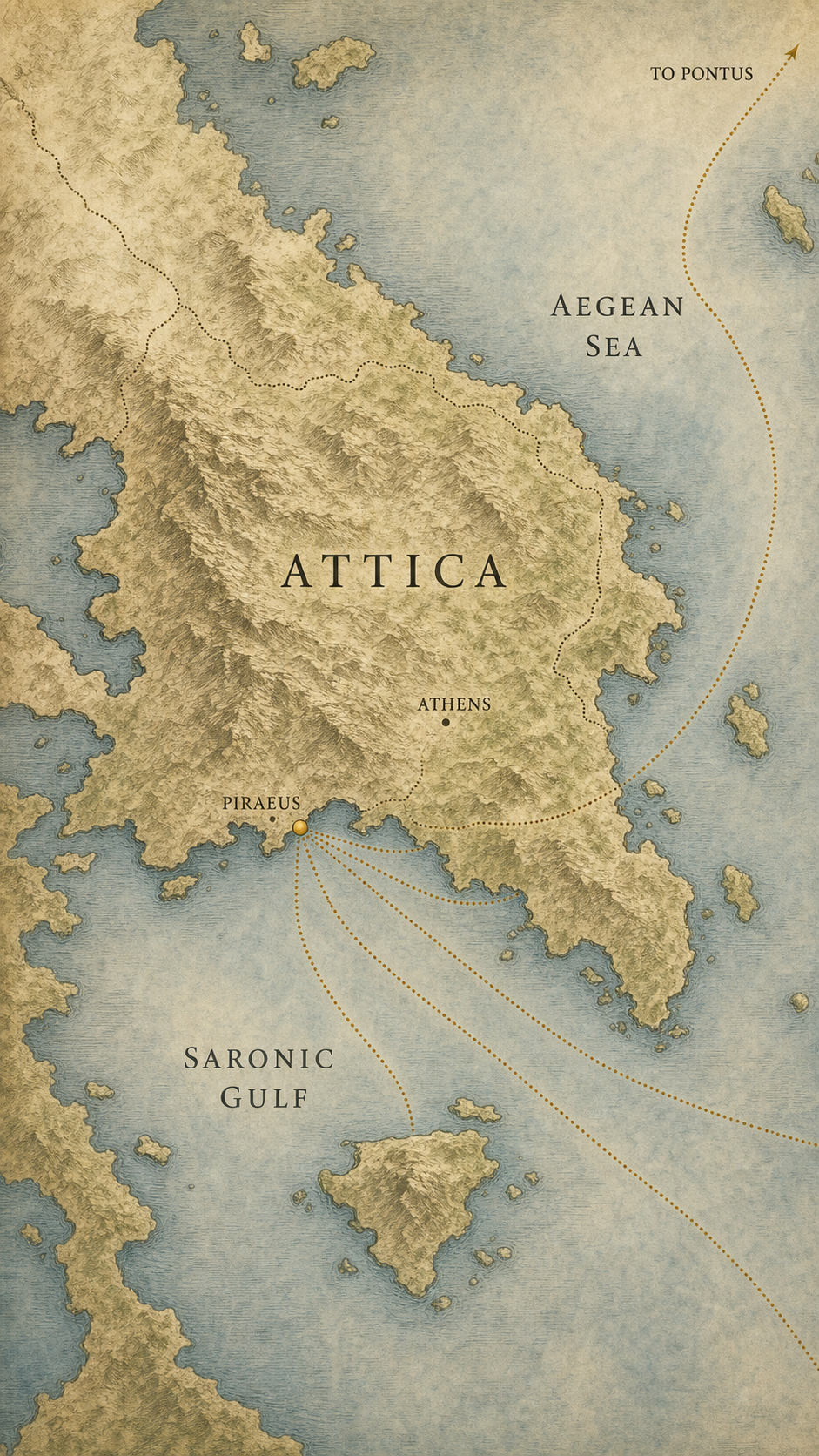
Before insurance existed, ancient Greece ran cargo on maritime loans out of Piraeus: if the ship sank, the debt sank with it — and men lied to the lender about both. One contract survives at 22.5% per voyage; one shipowner was accused of cutting open his own hull at sea.
The bargain at the harbor
Piraeus, the port of Athens, in the middle of the fourth century BC: the grain that fed the city, the wine that paid for it, and the silver that moved both — the engine of ancient Greek trade. Almost every cargo sailed on borrowed money — the maritime loan, nautikon daneion, what later law would call bottomry. The terms were unlike anything a modern bank would write. The lender handed over his silver before the voyage. If the ship came home, he was repaid with a premium of roughly a quarter. If the sea took the ship, he got nothing at all — the debt died with the cargo. It was not insurance; the merchant paid nothing up front, and the lender carried the whole risk of the sea inside the loan itself. But it did the job insurance would later do, and it is the closest thing the ancient Mediterranean had.
We know the terms exactly, because one contract survives word for word, read out in an Athenian courtroom and copied into the speech that quoted it ([Demosthenes] 35, Against Lacritus). Two lenders advance 3,000 drachmas on a voyage from Athens to the north Aegean, on to the Black Sea, and home again. The interest: 22.5 percent for the round trip — rising to 30 percent if the borrowers sailed home late in the season, after the rising of Arcturus, the star whose appearance marked the beginning of the autumn storms. The premium was priced to the danger, star by star.
Three thousand jars of wine
The reason that contract survives is that everything about the voyage went wrong — or, as the lender told the jury, was wrong from the start. The borrowers had pledged three thousand jars of Mendaean wine as security. By the creditor's account they loaded about 450 — roughly one jar in seven — and then borrowed more money from other lenders against the same cargo they had already pledged. When the ship's return was overdue, the story arrived before the ship did: the goods, the borrowers said, had been lost in a wreck. The wreck itself was real; the speech concedes a vessel had gone down on that route. What the creditor disputed was that his security had ever been aboard.
The speech preserves the lender's routine almost as a job description. He questions the ship's people. He gathers depositions. And he keeps watch at the harbor — by his own account for more than twenty-five days — waiting to see what actually came off the boats. It is due diligence, four centuries before the phrase: the work of a man whose entire profit depended on other people's stories being true.
The man accused of sinking his own ship
The most spectacular accusation in the surviving speeches goes a step further than lying about a wreck. In [Demosthenes] 32 (Against Zenothemis), a shipowner named Hegestratos is said to have borrowed money in Syracuse against a cargo of grain he had never loaded — and then, two or three days out at sea, gone below at night to cut through the hull of his own ship, so that the 'loss' would cancel the debt. By the speaker's account the passengers caught him at it; he went overboard, and everyone else reached shore. It must be read as it survives: one side of a lawsuit, delivered by an interested party. No verdict survives, and Hegestratos never got to tell his version.
What the case shows beyond doubt is that the scheme was thinkable — that Athenian jurors could be asked to believe it without laughing the speaker out of court. Athens — whose whole economy rode through the port of Piraeus — took this class of dispute seriously enough to route maritime suits through a fast procedural lane: the 'monthly cases', designed on the traditional reading to be settled within the month. A merchant's sailing season was short; justice at walking pace was no justice at all. Twenty-four centuries later the paperwork is better, the courts are slower, and the stories a claims adjuster hears have not changed.
Sources
- [Demosthenes] 35 (Against Lacritus) 10–13 — the maritime loan contract quoted verbatim: 3,000 drachmas at 22.5% per voyage, 30% if sailing home from Pontus after the rising of Arcturus, secured on 3,000 jars of Mendaean wine. Trans. A. T. Murray (Loeb, 1936)
- [Demosthenes] 35.18–23, 29–31 — the fraud claims: about 450 jars loaded of the 3,000 pledged, further borrowing on the same security, the cargo said to have been lost in another vessel's wreck, and the creditor keeping watch at the harbor for more than twenty-five days
- [Demosthenes] 32 (Against Zenothemis) 4–8 — the Hegestratos accusation: borrowing in Syracuse against grain never loaded, the attempt to cut through the hull two or three days out at sea, the passengers catching him in the act, his leap overboard. Trans. A. T. Murray (Loeb, 1936)
- Aristotle (attrib.), Athenian Constitution 52.2 — maritime suits (dikai emporikai) heard among the 'monthly cases', the fast lane of Athenian commercial justice
- Encyclopaedia Britannica, 'Bottomry' — the loan form's afterlife: the same sea-loan structure survived into early-modern marine finance before premium insurance replaced it
- Athenian silver tetradrachm (the 'owl'), c. 440–404 BC — The Metropolitan Museum of Art, Open Access (public domain); the coin type the loans were counted in
- The Peristera shipwreck, Alonnisos, Greece — a merchantman of c. 425 BC that went down with over 3,000 amphorae; aerial photograph by dronepicr, CC BY 2.0 (cropped)
.jpg)
Tell us in the comments — the next episode is picked from what you ask for.
Subscribe on YouTube Watch the seriesMore from the series

The Guides Nobody Could Stop

The Complaint That Outlived the Merchant