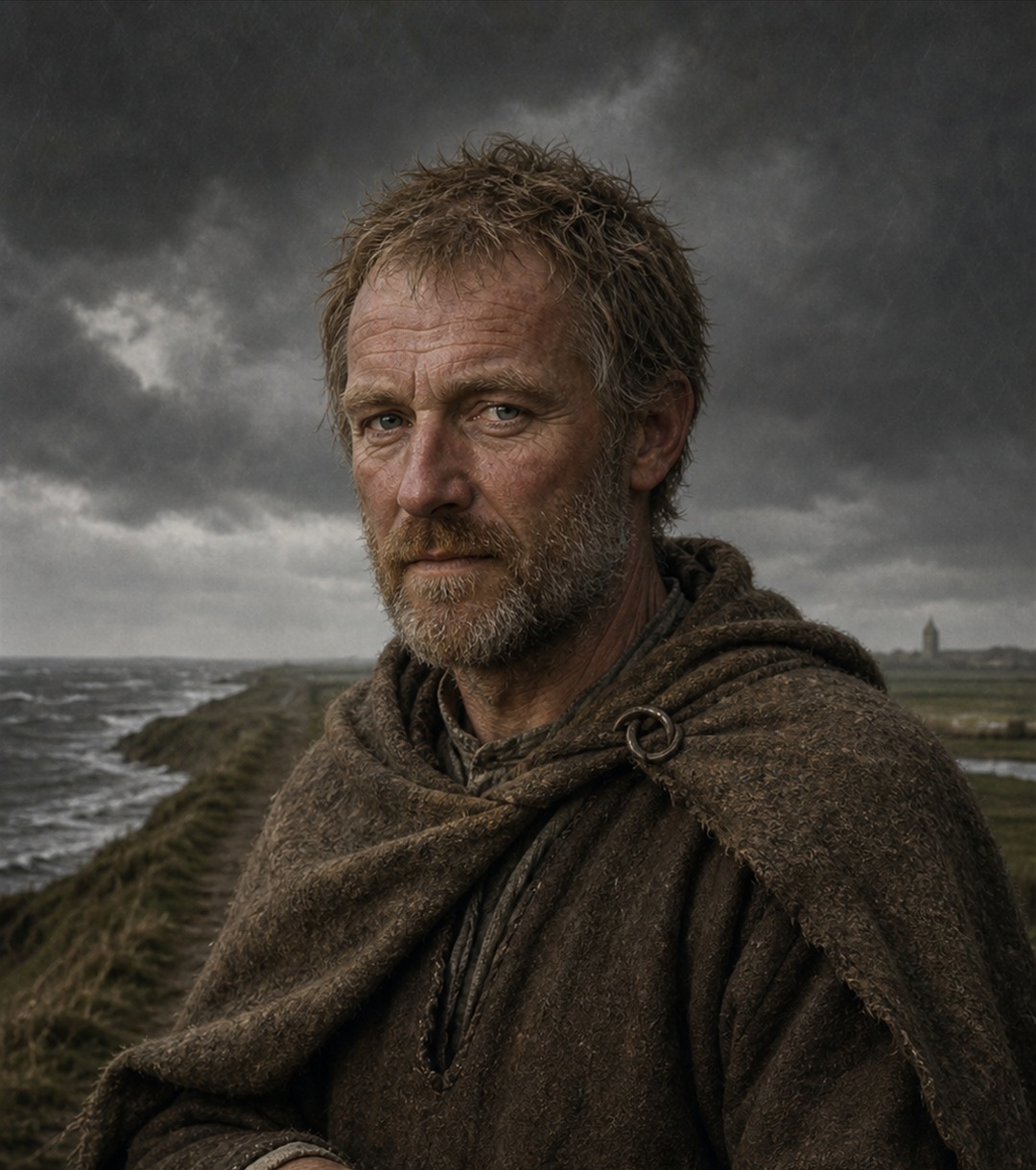
The Men Who Audited the Sky
- Civilization
- Shang China
- Occupation
- Oracle-bone diviner of the Shang royal workshop
- Material
- Shell & fire
- Period
- c. 1200 BC
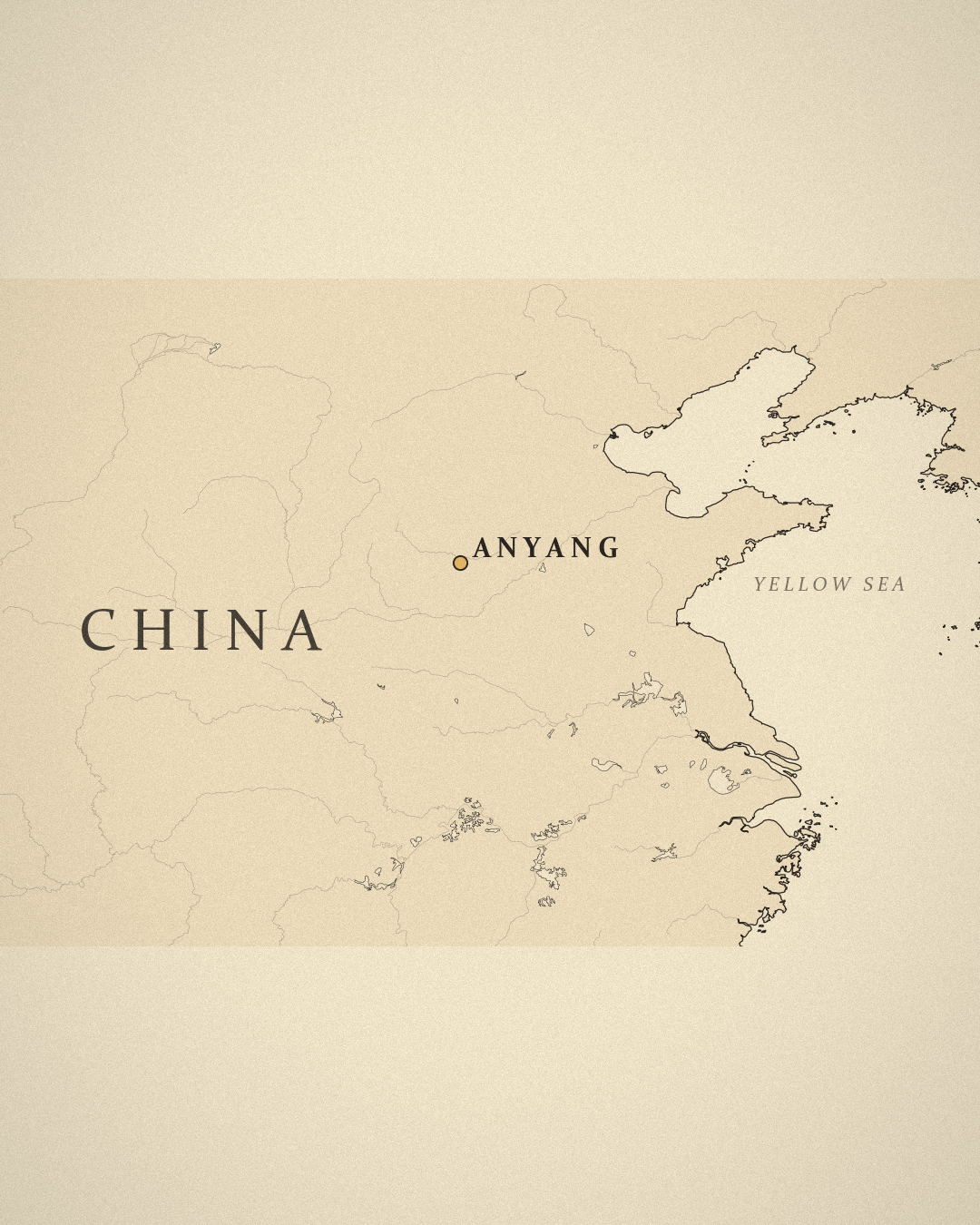
Anyang, around 1200 BC: an oracle bone diviner of the Shang dynasty cracks turtle shells to forecast rain for the king, and the workshop carves beside the king's reading what the sky actually did. On the archive's most famous shell the king promised rain on a certain day; four rains fell in eighteen days, none on his. One pit held about 17,096 inscribed pieces, the script on them is the direct ancestor of modern Chinese characters, and about 2,000 of the known characters still cannot be read. One working day in the royal divination workshop, rebuilt from catalogued shells.
A forecast you could hold
The working object was a turtle plastron, the flat underside shell, or the shoulder blade of an ox. The back was prepared with ordered rows of chiseled hollows, each one thinning the bone almost to the far surface. A question was put in paired form, rain and no rain, and a glowing hardwood brand was pressed to a hollow until the bone split with an audible pop. The crack ran across the smooth front face, and the sign it made was the answer. A single divination could consume a run of numbered cracks, and the standard charges were repeated in sequences, so one question from the king could use up ten hollows before the day was out.
The king's privilege
Reading the cracks was not the diviner's job. In the fullest records from the reign of Wu Ding, a named diviner such as Que or Zheng performs or sponsors the cracking and states the charge, and the king gives the prognostication. On one shell, catalogued today as HJ 902, the diviner Que put both outcomes to the shell, the king chose a day class for the rain, and a later line records the result on a named day: it really rained. The verification could be terse, or it could read like a weather log, with time of day, direction, cloud, thunder and clearing.
The shell that came back
The reason every shell came back to the workshop is that the record was not finished when the king spoke. Some inscriptions carry verification postscripts added after the fact. The strongest case is HJ 12487, divined by Zheng, on which the king committed to rain on a bing day. The workshop then followed the weather for at least eighteen days and carved in four separate days of rain, date by date. None of them was a bing day. The scholar David Keightley read this open-ended record as the staff waiting for the king's day to arrive, a reading, not a recovered confession, but the carved dates themselves are simply there, and none of them matches the forecast. The same physical shell carries a delivery notation recording that Que handed in a batch of two hundred and fifty shells, so the man whose name opens our episode is attested on the very object that preserved the king's miss.
One pit
The scale of the archive surfaced in 1936, when excavators at Yinxu opened storage pit YH127 and found it packed with inscribed pieces, about 17,096 of them by the standard count. The find turned oracle-bone study from market collecting into contextual archaeology. The archive is royal and selective, most preserved outcomes favor the king, which makes the surviving misses more interesting, not less: someone chose to keep them.
Dragon bones
For a long stretch of the late imperial centuries, old bone and shell from the Anyang plain moved through Chinese pharmacies as longgu, dragon bones, ground up for medicine. Some inscribed pieces certainly entered that trade, and nobody can now count what was lost to it. In 1899, inscribed pieces moving through the Beijing trade reached antiquarian scholars, and Wang Yirong is conventionally credited with recognizing ancient writing on them. A later legend places the discovery in his own malaria prescription, but that scene was first printed decades after the event.
The sign for rain
The oracle-bone inscriptions are the earliest securely readable corpus of Chinese writing, and from the late Shang onward the archaeological record shows a continuous written tradition leading to the characters in use today. The Shang sign for rain, a bar of sky over falling drops, is directly ancestral to the modern character on a Chinese weather app. About 4,500 distinct graphs are known from the bones, and roughly 2,000 of them still cannot be read. The National Museum of Chinese Writing has paid 100,000 yuan for a single newly accepted decipherment, once in 2018 and again in a second batch of awards announced in 2024. The forecasts were audited. The audit is still hiring.
Sources
- Keightley, David N. Sources of Shang History: The Oracle-Bone Inscriptions of Bronze Age China. University of California Press, 1978
- Smith, Adam Daniel. Writing at Anyang: The Role of the Divination Record in the Emergence of Chinese Literacy. UCLA, 2008
- Schwartz, Adam Craig. The Oracle Bone Inscriptions from Huayuanzhuang East. De Gruyter, 2019
- Jing, Zhichun et al. 'Radiocarbon Dating of Oracle Bones of the Late Shang Period in Ancient China.' Radiocarbon 58.2 (2016)
- Li Ling. 'Scholarship on Oracle Bones: Retrospect and Prospect.' Chinese Studies in History 53.3-4 (2020)
- Li Zong-kun, introduction to The Chinese University of Hong Kong Oracle Bone Collection. CUHK Press, 2023
- Institute of History and Philology, Academia Sinica: the Anyang excavations and pit YH127
- Academia Sinica Museum: the HJ 12487 shell (R044802)
- National Social Science Work Office: second batch of oracle-bone decipherment awards, 11 January 2024
- National Social Science Work Office: the 100,000 yuan reward call, 2019
- UNESCO World Heritage: Yin Xu
- CUHK Multi-function Chinese Character Database: oracle-bone graph forms
- Inscribed bone, Shang dynasty. The Metropolitan Museum of Art, 67.43.14
- Inscribed ox scapula (Heji 40610). British Library Or.7694/1595

Tell us in the comments — the next episode is picked from what you ask for.
Subscribe on YouTube Watch the seriesMore from the series
Five Most Costly Purples
The Flower of the Mackerel