
The Flower of the Mackerel
- Civilization
- Roman Hispania
- Occupation
- Garum maker
- Material
- Salt & fish
- Period
- c. AD 100
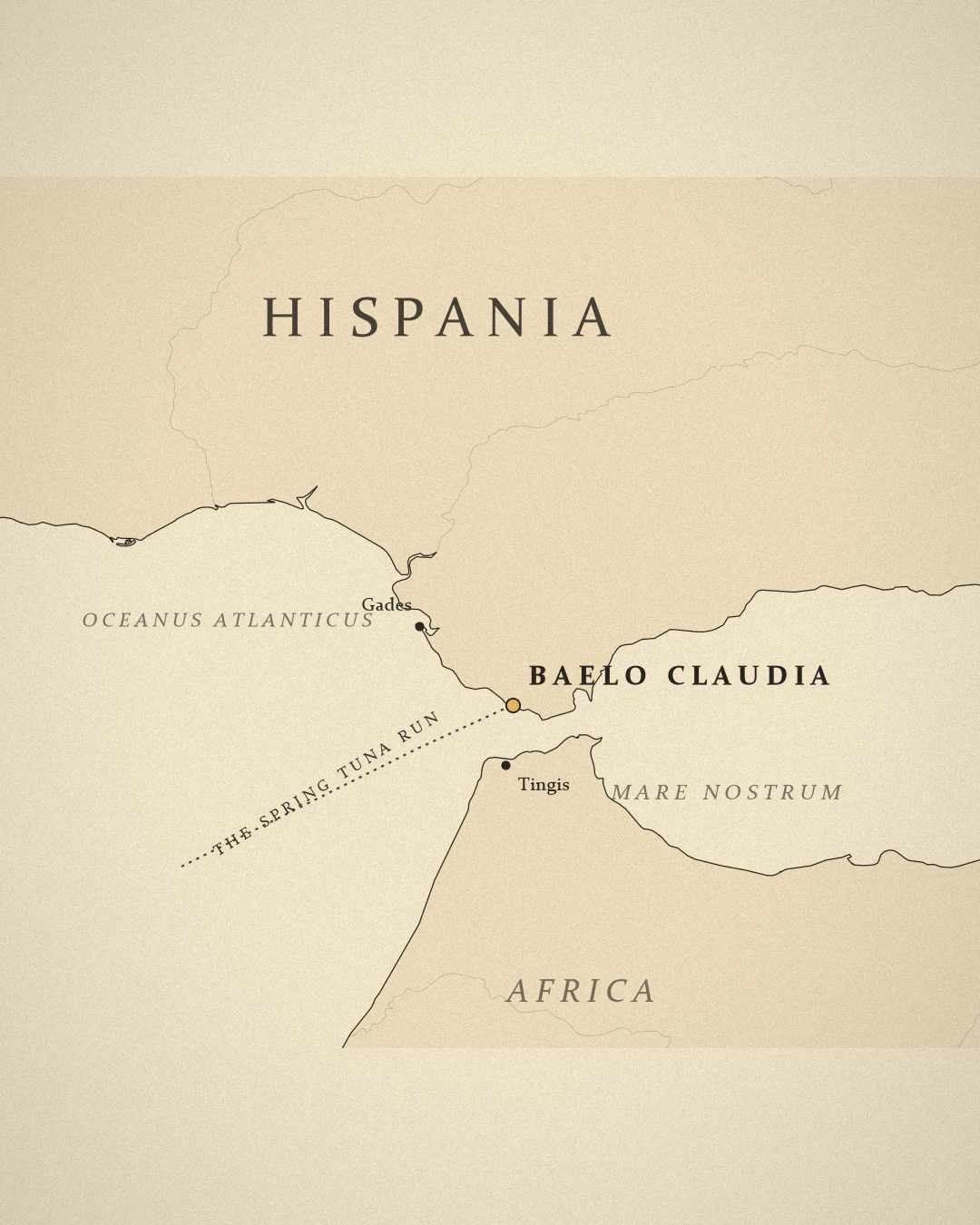
Baelo Claudia, around AD 100: one working day in a garum factory on the Atlantic coast of Roman Spain, where whole fish and coarse salt became the Roman fish sauce that Pliny said almost nothing but perfume could outprice. The vats sit inside the town walls, some of them deeper than a man is tall. The surviving recipe is one part salt to eight of fish and two to three months of waiting. The jars went out painted with the grade and the fish, and one of them reads flower of mackerel garum.
The yards inside the walls
Baelo Claudia stood on the Atlantic shore at the mouth of the Strait of Gibraltar, looking across at Africa. Its fish-salting works are not out of town somewhere downwind. They are inside the walls, down by the beach, a short walk from the forum and the temples, which is worth saying plainly because the usual story is that the smell pushed salteries out of every Roman town. At Baelo the vats sit in rows, cut into a paved court that slopes so water and residue could be cleared. Some of them are deeper than a man is tall. The same district handled tuna, sardines, anchovies and whatever else the nets brought in.
One part salt, eight parts fish
The fullest method to survive sits in the Geoponica, a late compilation of older farming and household writing. It gives two measures of salt to sixteen of fish, which is one to eight, and it leaves the mixture two to three months. Other passages describe stirring a batch and straining the liquid through a close woven basket. What ran off was the sauce. What stayed behind was a thick residue, allec, which could go to the workforce, although expensive versions of that existed too.
The salt is doing as much work as the fish. This is not fish left to rot in the sun, whatever the Roman satirists implied. It is fish held in enough salt that the wrong bacteria cannot get going, while the fish's own gut enzymes break the flesh down into a clear savoury liquid. There was no single ratio and no single waiting time across the Roman world, and the surviving accounts disagree with each other.
What Pliny says it cost
Pliny the Elder gives a number, and it is worth quoting carefully because it travels badly. He says that roughly two congii, about six and a half litres, of the top sauce made at Cartagena sold for 1,000 sesterces, and that scarcely any liquid apart from perfume came to be valued more highly. Set against a legionary's gross base pay in the same period, that is somewhere between ten months and a little over a year of wages.
Two things follow, and both get lost when the figure is repeated. The price is for one luxury line from one town, and no price survives for what Baelo's own jars fetched. And perfume was still the dearer liquid, not the cheaper one.
Seneca, arguing about luxury, called the same product the costly discharge of bad fish. Martial treated mackerel garum as a gift worth naming and joked that a cheaper tuna sauce was what his friend could afford. These are moralists and satirists rather than price lists, but they agree about the shape of the thing. It was expensive, and everybody knew it.
The name on the jar
The jars went out labelled in paint. One surviving formula reads G F SCOMBRI, which opens out as gari flos scombri, the flower of mackerel garum: the top draw off a mackerel batch. Labels could carry the product, the grade, the fish, the age, a workshop, personal names and where the jar was headed. Baetican jars turn up in Rome, in Britain and on the Rhine frontier.
At Pompeii a man called Aulus Umbricius Scaurus had four labelled sauce vessels set into the mosaic floor around his atrium pool, and three of them name him or his workshop. Surviving jars tie his name to more than one workshop. That looks like something between a maker's mark and a franchise, though what the arrangement was in law is not known. What can be said is that a Roman buyer could choose sauce by a name, and that the name was part of what they paid for.
Why anyone wanted it
Fish sauce gave Roman cooking free glutamate, the savoury taste now called umami. There was no soy sauce in the western Mediterranean, no stock cube, no bottle of concentrate. Fish sauce was how a cook made food taste of more than itself, which is why it runs through most of the recipes in the collection that comes down under the name of Apicius. It was the seasoning and the salt at once.
Scholars still argue about whether garum and liquamen named two different products or the same one at different dates, so the neat ladder of garum, liquamen, muria and allec that gets printed in popular accounts is tidier than the evidence.
What is left
The people who worked these vats left almost no names. The inscriptions of the fish trade preserve merchants and workshop owners far more readily than the hands in the court, and the status of any individual worker at Baelo, free, freed or enslaved, is a reconstruction rather than a record.
The sauce did better than the workers. Researchers at the University of Cadiz and the University of Seville worked from ancient recipe descriptions and residues in Pompeii jars, ran laboratory trials, and put a version on sale in 2014 under the name Flor de Garum. It was still being sold when we checked in August 2026. It is a defensible approximation of one Pompeian-style sauce rather than a recovered ancient flavour, and the people who made it say so.
The process never really left the Mediterranean either. At Cetara on the Amalfi coast, colatura di alici is anchovies and salt aged in barrels until an amber liquid can be drawn off, and it now carries a protected designation of origin. Nuoc mam and nam pla are living relatives that researchers use to reason about the ancient version. And off the Cadiz coast the bluefin are still taken in spring in a maze of nets called the almadraba, out of Barbate, Zahara, Conil and Tarifa, on the same run of water the Roman lookouts were watching.
Sources
- Junta de Andalucia, Conjunto Arqueologico de Baelo Claudia, 'Factorias de salazon'
- Bernal-Casasola, D., Exposito, J. A., Diaz, J. J., and Marlasca, R. 'Investigaciones interdisciplinares en los saladeros orientales de Baelo Claudia.' Melanges de la Casa de Velazquez 47-1 (2017), 153-172
- Bernal-Casasola, D., Exposito, J. A., and Diaz, J. J. 'The Baelo Claudia Paradigm: The Exploitation of Marine Resources in Roman Cetariae.' Journal of Maritime Archaeology 13 (2018), 329-351
- Pliny the Elder, Natural History 31.81 and 31.93-97, trans. Bostock and Riley
- Geoponica 20.46, trans. Thomas Owen, 1805-1806
- Seneca, Moral Letters 95.25, trans. Gummere
- Martial, Epigrams 13.102-103, Bohn edition, 1865
- Strabo, Geography 3.1.8, trans. H. L. Jones, 1917
- Oppian, Halieutica 3.620-648, trans. A. W. Mair, 1928
- Grainger, S. 'Garum and Liquamen, What's in a Name?' Journal of Maritime Archaeology 13 (2018), 247-261
- Curtis, R. I. 'Umami and the Foods of Classical Antiquity.' American Journal of Clinical Nutrition 90 (2009), 712S-718S
- Curtis, R. I. 'Sources for Production and Trade of Greek and Roman Processed Fish' (2005)
- Amphorae Ex Hispania (ICAC), Dressel 7 and Dressel 8 epigraphy
- Roman Inscriptions of Britain, RIB 2492 instrumentum entries
- Garcia Vargas, E. 'The Fish-Salting Industry in Baetica' (2009)
- Wilson, A. 'Quantifying Roman Fish-Salting Production.' Oxford Roman Economy Project working paper
- Scheinman, T. 'Culinary Detectives Try to Recover the Formula for a Deliciously Fishy Roman Condiment.' Smithsonian (2021)
- European Union, Colatura di Alici di Cetara PDO single document, Official Journal C/2025/1613
- Andrews, A. J., Di Natale, A., Bernal-Casasola, D., et al. 'Exploitation History of Atlantic Bluefin Tuna in the Eastern Atlantic and Mediterranean.' ICES Journal of Marine Science 79.2 (2022), 247-262
- Perez-Llorens, J. L. 'Bluefin Tuna and Cadiz: A Pinch of History and Gastronomy.' International Journal of Gastronomy and Food Science 17 (2019)
Tell us in the comments — the next episode is picked from what you ask for.
Subscribe on YouTube Watch the seriesMore from the series
The Men Who Audited the Sky

The Ambassador Who Reviewed an Empire