
The Wall With a Thousand Names
- Civilization
- The Low Countries
- Occupation
- Dike-holder on the river wall, judged by his sworn neighbors three times a year
- Material
- Sod & clay
- Period
- 1288 AD
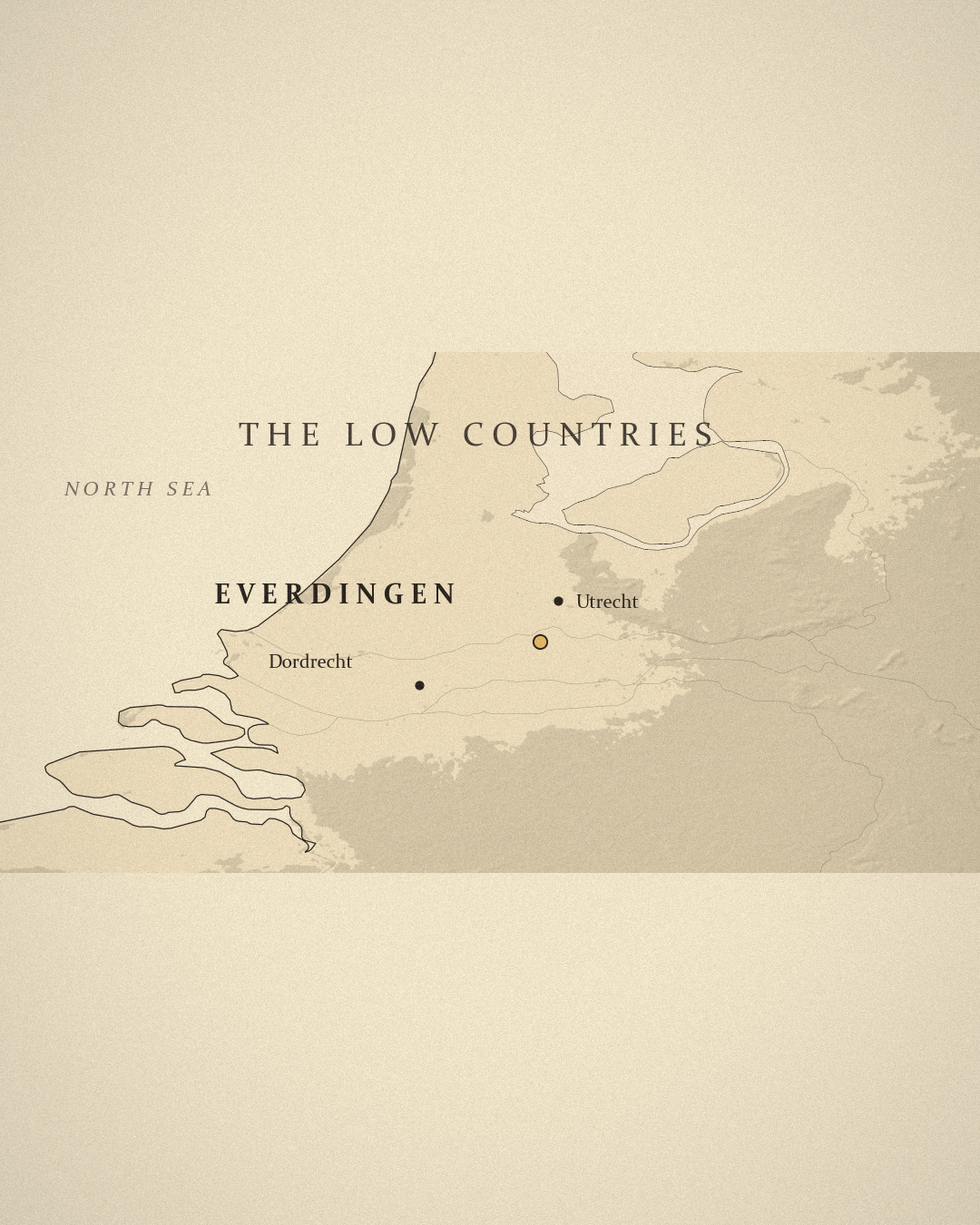
Holland, 1288: every farm came with a stretch of dike attached, and the Dutch water boards that enforced it are among Europe's oldest continuous public institutions. Three times a year the sworn neighbors walked the wall and judged every seam. Fail: a fine. Ignore it: the inspectors dined at your cost until you finished. Abandon the dike: the court took the land it protected, forever. One working day on the wall, rebuilt from the 1284 and 1287 charters.
A country below its own rivers
The Dutch river country was not conquered by the sea. It sank. From roughly the tenth century, settlers cut parallel drainage ditches into raised peat bogs and turned wetland into farmland. Drained peat compacts and oxidizes, so the ground fell, generation after generation, until wide districts lay below the rivers that crossed them and the dutch dikes that held those rivers out became the condition of everything else. Historians call this the reclamation trap: the work that made the land useful is the work that made it drown. By the thirteenth century much of the Netherlands sat below sea level or within reach of flood, and the numbers are still striking today, with about 26 percent of the country below the North Sea datum. William TeBrake, the historian of medieval Rijnland, reconstructed the sequence: drainage, subsidence, deeper drainage, dikes, and then institutions to force the dikes' upkeep, because one failed section could put a whole district under water.
The section with your name on it
Dike law bound land, not volunteers. A holding came with a stretch of the common dike, and the duty passed with the land to whoever held it. A charter of 1287 shows Count Floris V allowing one lord to gather each man's scattered dike pieces 'at one place', with the local heemraden, the sworn neighbor-judges, dividing the line into sections. The formula behind it was simple and merciless: whoever the dike protected, maintained it. Three times a year in the river country's 1284 charter tradition, the sworn men walked the line and judged each section, at dates like Saint Martin's Eve in November, with a re-inspection after each round. A failed section drew a fine of five schellingen, roughly three days of a laborer's pay by a near-date Dordrecht wage, and an unmade dike drew more, with repair billed to the holder.
The inspectors will have dinner now
The same 1284 charter tradition preserves the schouw's most human sanction. When a rejected section was still unrepaired, the inspectors could move to the nearest inn and wait there, eating and drinking at the defaulter's expense, until the work passed. The legal historian H. van der Linden calls this the teerschouw, the 'dining inspection'. It is the medieval Low Countries in one rule: no dungeon, no drama, just a bill that grows until you do your duty. The comparison that modern viewers reach for, a homeowners association with mortal stakes, is an analogy rather than an identity. The medieval body was part court and part public-works authority, its dues were often labor rather than money, and the shared wall it enforced held back the water that could kill everyone behind it.
The winter of 1287 and the law that closed the door
In December 1287 the St Lucia's flood cluster broke the coastal dikes from Frisia to Flanders. One chronicle claimed fifty thousand dead; the true toll is unknown, and modern historians treat the number as literary rather than counted. What is certain is that the catastrophe fell on a landscape already sinking, and that the burden of the wall could be heavier than some holders would bear. In 1292 Count Floris V confirmed a judgment from the Riederwaard: any man who abandoned his dike while it still stood lost that standing dike to the lord of the district, forever. The parchment says nothing about the famous spade thrust into the dike as a gesture of surrender; that wording appears in later centuries. The thirteenth-century rule was quieter and harder. The duty ran with the land, and there was no walking away from it with the land in hand.
Seven centuries of the same bill
The finger-in-the-dike boy, for the record, is fiction, and not even Dutch fiction: the tale circulated in print by the 1820s and an American novel made it famous in 1865. The real defense never needed him. It needed named sections, sworn neighbors, fines, and the patience of inspectors with an appetite. That machinery never stopped. The Netherlands today has 21 water authorities, public bodies with their own elections and their own taxes, and Rijnland, whose heemraden appear in a charter of 1255, still governs water under the same name, which places the water boards among Europe's oldest continuous traditions of specialist public administration. They are not, as the popular claim goes, the world's oldest democracies; the medieval colleges were co-opted and elite, and residents only began voting directly in the 1990s. But when a Dutch household's water-authority bill arrives, it settles a debt first written into the land more than seven hundred years ago, in the polder country the dikes still keep dry.
Sources
- Van den Bergh, Oorkondenboek van Holland en Zeeland II, nos. 621 (1287) and 814 (1292)
- Kemp, Leven der doorluchtige heeren van Arkel (1656) — the 1277/1284 charter summaries
- Van der Linden, 'Waterstaatsorganisatie' (BMGN 1988) — hoefslag, schouw, teerschouw
- Van Tielhof, Consensus en conflict (2021) — the two-stage origin of the water boards
- TeBrake, 'Taming the Waterwolf' (Technology & Culture, 2002) — the reclamation trap
- Van Tielhof, 'Waterschappen als de oudste democratische instellingen' (2015) — the democracy myth's history
- Soens, 'Resilient Societies, Vulnerable People' (Past & Present, 2018) — flood tolls and recovery
- Brown, thesis on the 1287-88 flood cluster (Durham, 2019) — the 50,000 chronicle notice
- van Popta et al., 'Reconstructing medieval eroded landscapes of the Zuyder Zee' (2020)
- Hoogheemraadschap van Rijnland, institutional history and the 1255/1286 charters
- Johnston, the Pan-Frisian Dike Law (Us Wurk, 1995)
- COELO Atlas van de lokale lasten 2026 — water-authority household charges
Tell us in the comments — the next episode is picked from what you ask for.
Subscribe on YouTube Watch the seriesMore from the series

Cold Hands, Bad Ink

One Letter for Every Sound