
Five Most Costly Purples
- Civilization
- Byzantium
- Occupation
- Kommerkiarios, the sealing official at the empire's export line
- Material
- Lead & silk
- Period
- 968 AD
Constantinople, 968 AD: Byzantine officials open an ambassador's luggage and take five costly purple silks, exactly as the export law required. The officials were the kommerkiarioi, who sealed lawful goods in lead and enforced the forbidden list. The ambassador was Liutprand of Cremona, and his furious report on 120 days in the capital survives, from the promise he says the emperor made him down to the refund he never says he received. One working day at the empire's export line, rebuilt from the Relatio.
An ambassador, searched
In the summer of 968 Liutprand, bishop of Cremona, arrived in Constantinople as ambassador of the western emperor Otto I. His mission was a marriage: a Byzantine princess for the young co-emperor Otto II. It failed almost completely, and on the way to failing it generated one of the angriest documents of the Middle Ages, the Relatio de legatione Constantinopolitana, his official report of roughly one hundred and twenty days of grievances. The wine was undrinkable to him. The lodging let in wind and water. At the emperor's table he was seated fifteenth, behind a Bulgarian envoy, and he walked out about it.
The scene this episode reconstructs sits near the end of that stay. On 17 September, by his own account, Liutprand was received at the palace by Christopher, a court eunuch holding the rank of patrikios, who rose to meet him with three other senior officials. What followed, as the narrative runs on continuously, was an export inspection: his baggage opened, his textiles laid out, and a ruling delivered.
One honesty note on our framing. Calling this the world's first customs seizure is a modern shorthand, and the question mark in our title is doing real work. The inspection happened through the palace chain of command, at an audience, not at a dock, and Liutprand names no customs officer, no harbor office, and no statute. What he documents is an export-control confiscation carried out on a departing diplomat, argued out loud, in detail, with the paperwork surviving. Seizures of forbidden exports were certainly older than 968. This is simply the one whose victim wrote it all down.
The forbidden list
The officials' order, in a close translation of Liutprand's Latin, ran like this: the cloths suitable for him would be marked with a lead seal and allowed, while those which were kolyomena, that is, forbidden to all nations except the Romans, would be taken away with the price returned. The Greek word sits untranslated in his Latin text, and it is the closest thing the scene has to a legal citation: the category of goods that did not leave the empire.
At the top of that category stood high-grade purple silk. The Book of the Eparch, the regulation book of Constantinople's urban prefect compiled around 911 to 912, forbids selling protected grades of large purple silk goods to foreigners, orders garments worth ten nomismata or more to be declared, and requires goods meant for export to be inspected and sealed. The officials in Liutprand's account do not cite any of this. Connecting his seizure to those exact provisions is strong context rather than a quotation from his case file. But the shape matches: a controlled category, a declaration threshold, and a seal that made cloth legal to move.
The officials also gave him a second reason, and it is the more revealing one. As the Romans surpassed other nations in wealth and wisdom, they told him, so they ought to surpass them in dress. Imperial purple was not being hoarded as merchandise. It was being guarded as a uniform of sovereignty, and the empire had opinions about who wore it.
The men with the tongs
The lead seal in that order had a professional behind it. The kommerkiarioi were the empire's fiscal officials for trade, spread across ports, districts, and themes, and hundreds of their personal lead seals survive, naming the man and his station. The title has a long history and changed meaning across it: from the seventh century a series of general kommerkiarioi tied to imperial warehouses, and from the 830s onward imperial kommerkiarioi attached to specific provinces and ports. Our inspector is a reconstruction of the middle Byzantine type, the man at the export line with a pair of sealing tongs.
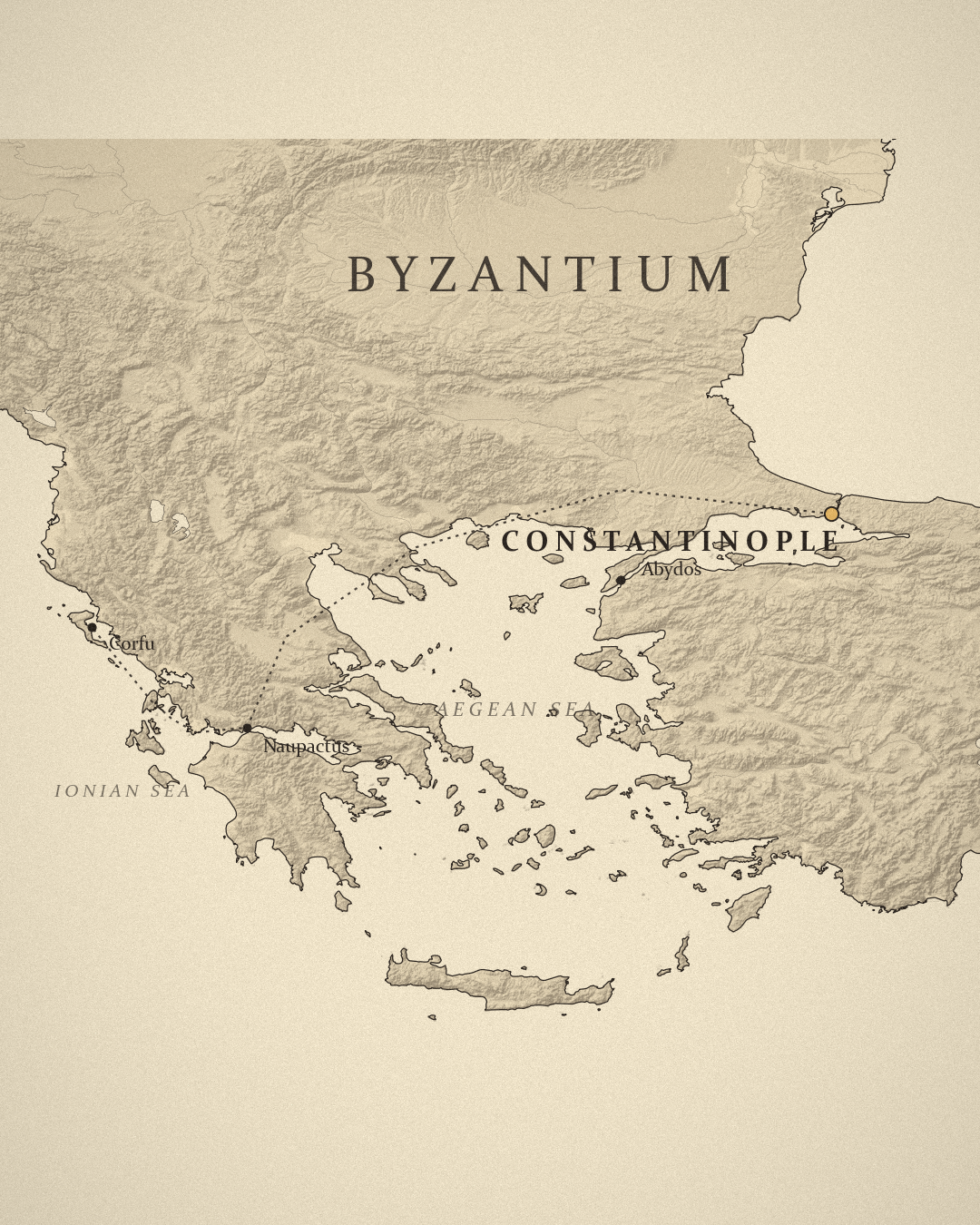
The great toll stations show how physical the system was. Abydos guarded the narrows toward the Sea of Marmara, Hieron the Black Sea mouth of the Bosporus, and a ship passing either paid at the window. A privilege issued to Venice in 992 fixed the toll at Abydos at two solidi on entry and fifteen on departure, and in the same breath barred the ordinary port staff from boarding privileged Venetian ships, which tells you exactly what the ordinary experience of the ordinary trader was.
Liutprand himself gives the system its everyday texture in one aside: his cleared cloths were stamped, he says, in the Venetian manner. Inspection and sealing were routine enough to have a house style.
Five most costly purples
Then the officials took, in his words, five most costly purples. Liutprand's protest is preserved as direct speech, and it is a contract lawyer's protest: where is the emperor's word? He had asked Nikephoros for leave to buy cloths at any price for the honor of his church, and the emperor, he says, had answered with quality and quantity unrestricted, making no exception. He names his witnesses: Leo the curopalates, the emperor's own brother, the interpreter Euodisius, John, Romanos, and himself, since he understood the Greek without help.
The ruling came back flat: those words could never have covered these. A general permission did not override the forbidden category, and the category was the point.
So Liutprand tried scorn. In his country, he told them, this cloth was worn by cheap streetwalkers and conjurors, and Venetian and Amalfitan traders sold it to anyone. The recorded answer is a threat in the future tense: they will do this no longer, and whoever is found carrying it will be searched, beaten, and shorn. He tried a compromise last, begging them to take the purchased cloths and spare the ones his friends had given him as gifts. The final reply, as he reports it, closed even that door: the given and the bought alike would return, in their phrase, by the same road. The refund the original order promised is the one thing the report never confirms. The price was ordered returned. Liutprand never records seeing it.
The report outlived the empire
The enforcement did not end at the palace. On the road home, weathered in at Corfu in the winter, Liutprand had his baggage turned over again by an official hunting for hidden purple, and says he had to stop the man taking one more cloth. He reached Italy and wrote the Relatio, a report so vivid in its fury that it remains a primary source for everything from Byzantine court ceremony to the taste of resinated wine. Historians read it carefully: it is a polished, hostile defense of a failed mission, written for the patrons who sent him, and the speeches in it are Liutprand's speeches. The seizure itself, the category, the seal, and the second search are as solid as tenth-century evidence gets.
One legacy note, honestly hedged. The adjective byzantine originally named the place, its people, and its art. The sneer came much later: French had byzantin for excessive subtlety by 1846, in Michelet, and the English bureaucratic sense broadened into journalistic shorthand across the twentieth century. No single event coined it, and Liutprand's luggage is not the origin of the word. But when the modern paperwork gets bad enough, the word we reach for is still the name of the empire that searched him twice.
And the five silks themselves? The record simply stops. Nothing says they were burned, sold, stored, or worn. Our guess, and it is only a guess: back into the imperial stores, and handed out years later to some friendlier ambassador. As a gift.
Sources
- Liutprand of Cremona, Relatio de legatione Constantinopolitana, ed. Joseph Becker, Die Werke Liudprands von Cremona, MGH SS rer. Germ. 41 (1915), pp. 175-212 (the seizure at pp. 202-205)
- Relatio de legatione Constantinopolitana, Latin text (Migne PL 136 transcription)
- Paolo Squatriti (trans.), The Complete Works of Liudprand of Cremona (CUA Press, 2007)
- Angeliki Laiou, 'Exchange and Trade, Seventh-Twelfth Centuries' — the kolyomena regime and the silk ban (Économie et société à Byzance / EHB chapter, open edition)
- The Book of the Eparch (To Eparchikon Biblion, c. 911-912), ed. Johannes Koder, Das Eparchenbuch Leons des Weisen (1991); English trans. A. E. R. Boak (1929)
- Nicolas Oikonomides, 'Silk Trade and Production in Byzantium from the Sixth to the Ninth Century: The Seals of Kommerkiarioi', Dumbarton Oaks Papers 40 (1986)
- Archibald Dunn, 'The Kommerkiarios, the Apotheke, the Dromos, the Vardarios, and the West', Byzantine and Modern Greek Studies 17 (1993), pp. 3-24
- Klaus Belke, Bithynien und Hellespont, Tabula Imperii Byzantini 13 (2020) — Abydos and its kommerkiarioi, pp. 353-355
- Guillaume Saint-Guillain, 'Les Vénitiens et l'État byzantin avant le XIIe siècle' — the 992 chrysobull and the Abydos toll (open edition)
- Jon N. Sutherland, 'The Mission to Constantinople in 968 and Liudprand of Cremona', Traditio 31 (1975)
- Byzantine lead seal, 10th-11th century, Walters Art Museum 55.96 (CC0) — the episode's evidence cutaway
- Dictionnaire de l'Académie française, 'byzantin' — the figurative sense dated to the 19th century
Tell us in the comments — the next episode is picked from what you ask for.
Subscribe on YouTube Watch the seriesMore from the series

The Wall With a Thousand Names

Cold Hands, Bad Ink