
One Letter for Every Sound
- Civilization
- Armenia
- Occupation
- Scribe of the translation school, teaching letters that are three winters old
- Material
- Parchment & ink
- Period
- c. 405 AD
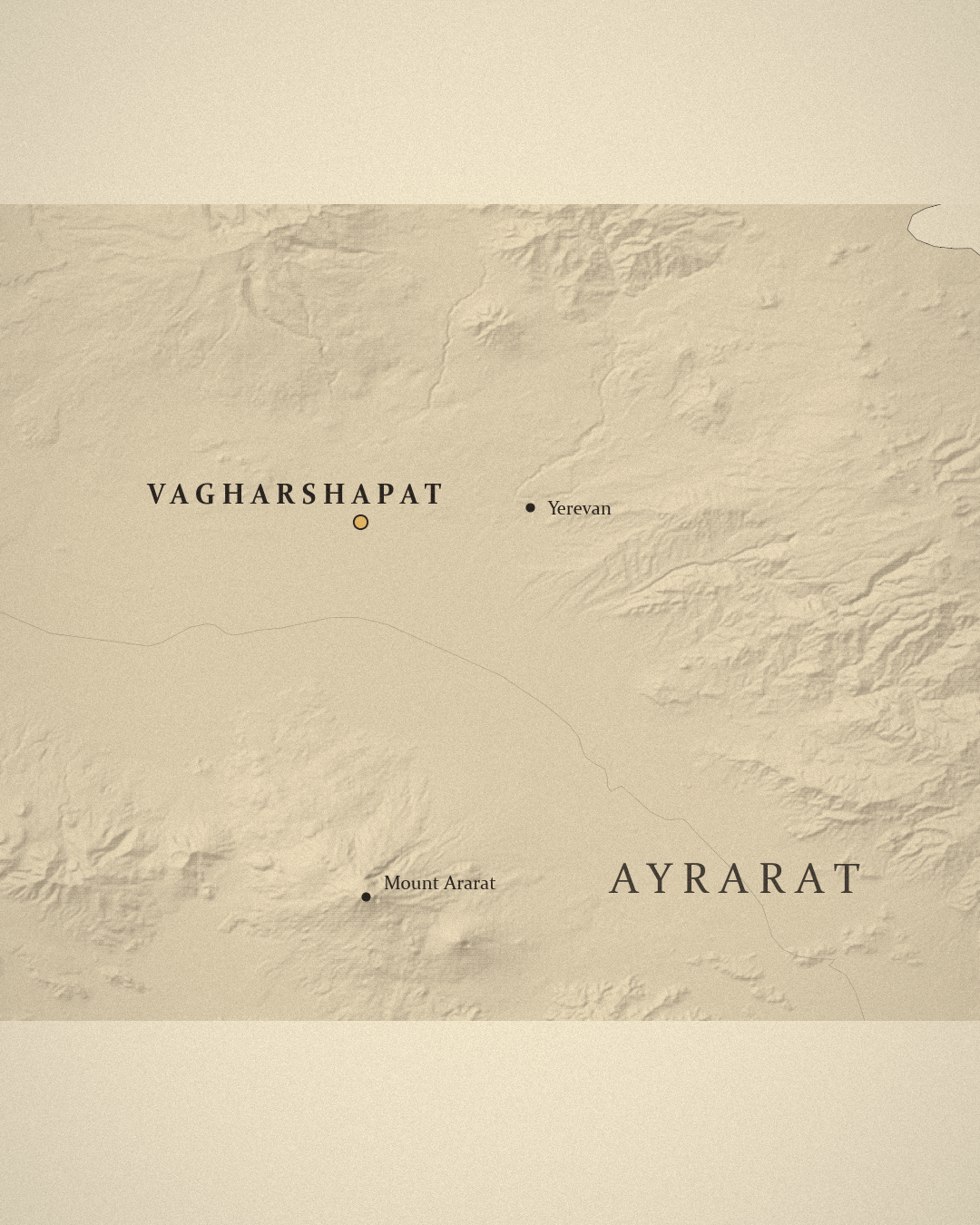
The Armenian alphabet, c. 405 AD: a language nobody could write, the borrowed script that failed, the monk who searched Edessa and Samosata, the first line from Proverbs set down by a scribe's hand, and the grandmother's legend of Hayk finally given letters. A day inside the first school.
A language without letters
At the turn of the fifth century, Armenian was spoken across a large and old country and written nowhere. Armenia had accepted Christianity roughly a century earlier, traditionally in 301, and its scripture, liturgy, and learning arrived in Greek and Syriac. A priest read; an interpreter translated aloud; the congregation received its own faith secondhand. The country itself had been partitioned between Rome and Sasanian Persia around 387, with the larger eastern share under Persian supremacy and an Arsacid client king, Vramshapuh, on its throne. The kingship would not survive another generation. The language had no letters of its own to hold what the nation knew.
A first attempt to fix this is recorded by Koriun, the earliest Armenian author whose work survives and a student of the man at the center of this story. A set of letters associated with a Syrian bishop named Daniel was tried and found insufficient for Armenian's sounds. Armenian is rich in consonants that Greek and Syriac scripts do not distinguish; the borrowed letters could not hold the language. The failure is part of the documented record, and it is why the alphabet that followed was built rather than adapted.
The search and the thirty-six
Mesrop Mashtots was a former royal secretary turned monk and missionary. With the backing of King Vramshapuh and Catholicos Sahak, he traveled into northern Mesopotamia, to Edessa, Amid, and Samosata, working with scholars and scribes on the problem of Armenian's sounds. Koriun presents the outcome in the language of revelation: the letters came to Mashtots in a vision. The tradition is the tradition, and the episode's narration marks it as such. What is beyond dispute is the result: thirty-six letters, one for each phoneme of fifth-century Armenian, ordered on the Greek model, capable of serving as numerals, and fitted to the language so well that linguists still note the match. Two more letters were added in the medieval period; the original thirty-six still anchor the alphabet Armenians use today.
In Samosata, Koriun records, the team began translating the Book of Proverbs, and the first line written in the new letters was Proverbs 1:2: to know wisdom and instruction, to perceive the words of understanding. Koriun names the hand that wrote it, and it was not Mashtots but the scribe Hropanos, a Greek calligrapher who then trained the first generation of young Armenian scribes. The popular retelling gives the first line to the saint; the source gives it to a scribe. This episode sides with the source, and with the scribes.
The school
No fifth-century Armenian schoolroom has been excavated, and the material culture of the first schools is reconstruction from regional evidence: plastered masonry or mudbrick, timber roofs, low benches, loose parchment for practice, reed pens, one scarce codex handled carefully. What the sources do give is the program. Mashtots and Sahak opened schools, gathered pupils, and sent advanced students to Edessa and Constantinople for Greek; teaching, worship, translating, and copying ran together. The episode's teaching stake is the documented one in miniature: a new script has no inherited habits, so every form a teacher fixes is a form his pupils will carry outward. Koriun's account of schools multiplying across the districts is the mechanism by which thirty-six letters became a national fact within a single generation.
The clothing in the reconstruction follows the broad Iranian dress zone of fifth-century Armenia, belted tunics and trousers and wool cloaks rather than the later monastic habit, and the winter is the Ararat plain's own: frost, breath, a small brazier, short daylight. Mount Ararat stands on the horizon as it stands over the plain today, across what is now the Turkish border.
God's words, and a grandmother's
The alphabet was made for scripture. Within about thirty years, the translators had produced an Armenian Bible, working first from Syriac and then revising against Greek manuscripts brought from Constantinople, a translation later scholarship would praise for its fidelity. The first generation of students, remembered as the Holy Translators, gave Armenia a written literature almost at a stroke: theology, history, liturgy. Armenia keeps a holiday for them still, Surb Targmanchats, the feast of the Holy Translators, and the church made Mashtots a saint.
But a script made for God's words could suddenly hold everyone's. The episode's night scene, a young scribe writing down the story his grandmother tells, is a reconstruction of exactly that transformation. The story he writes is Hayk: the archer-patriarch who refused the tyrant Bel of Babylon, led his household north to the land around Ararat, and killed the pursuing king with a single arrow, giving his people their own name for themselves, Hay, and their country, Hayastan. The fullest surviving version is in the History of the Armenians attributed to Movses Khorenatsi. It is a treasured legend, the story Armenians have told about their beginning for well over a thousand years, and the episode tells it with the love it is owed and no archaeology it cannot claim.
Sixteen centuries
The letters outlived everything around them. The kingdom that commissioned them ended in 428; the empires that partitioned the country are gone; the alphabet is on every school wall in Armenia and across a global diaspora, in every text message written in Armenian tonight. The Matenadaran in Yerevan holds thousands of manuscripts in Mashtots' letters and is named for him. The alphabet has its own monument at Artashavan, its own national holiday, and its maker has a saint's day.
The reconstruction in this episode follows the published evidence where it exists and says so where it does not. The manuscript pages on screen are real, an Armenian Gospel page of 1193 from the Walters Art Museum and the Avag Gospel of 1337 at the Matenadaran, both centuries later than the first school and honestly dated on screen: the tradition the first scribes founded, not the room they founded it in.
Sources
- Koriun, The Life of Mashtots, trans. Abraham Terian (Armenian Apostolic Church / Oxford, 2022; also the Miloyan translation online): the primary source — the Danielian letters, the journeys to Edessa and Samosata, the vision tradition, the 36 letters, Hropanos and the first Proverbs line, the schools.
- Michael Pifer, 'Mesrop Mastoc'' (Encyclopaedia Iranica, 2021): the scholarly overview; dating of the alphabet c. 404-406 and the state of the evidence.
- Movses Khorenatsi, History of the Armenians, trans. Robert W. Thomson (rev. ed. 2006): the fullest Hayk narrative (I.10-11) and the Hay/Hayastan etymology tradition.
- Nina Garsoian, 'Movses Xorenac'i' (Encyclopaedia Iranica, 2000): the dating dispute over the History (traditional 5th century vs. the later dating held by Thomson and many Western specialists).
- M.-L. Chaumont, 'Armenia and Iran ii' (Encyclopaedia Iranica, 1986/2013): the partition of Armenia (usually dated 387), Vramshapuh's client kingship, the end of the Arsacid monarchy in 428, and the marzpanate.
- S. Peter Cowe, 'The Bible in Armenian' (New Cambridge History of the Bible, 2012): the two-stage Bible translation completed c. 425-435 and early Armenian book culture.
- Dickran Kouymjian, 'The Archaeology of the Armenian Manuscript' (2014): erkatagir as the earliest book hand, materials, and the survival of the manuscript tradition.
- Theo Maarten van Lint, 'The Formation of Armenian Identity in the First Millennium' (2009): the alphabet within the long formation of Armenian identity under divided imperial rule.
Tell us in the comments — the next episode is picked from what you ask for.
Subscribe on YouTube Watch the seriesMore from the series
The Palace Fell. The Payroll Survived.
The Stone Was the Appointment