
Cold Hands, Bad Ink
- Civilization
- Ireland
- Occupation
- Monastic scribe, copying Priscian and complaining in the margins
- Material
- Vellum & ink
- Period
- c. 850 AD
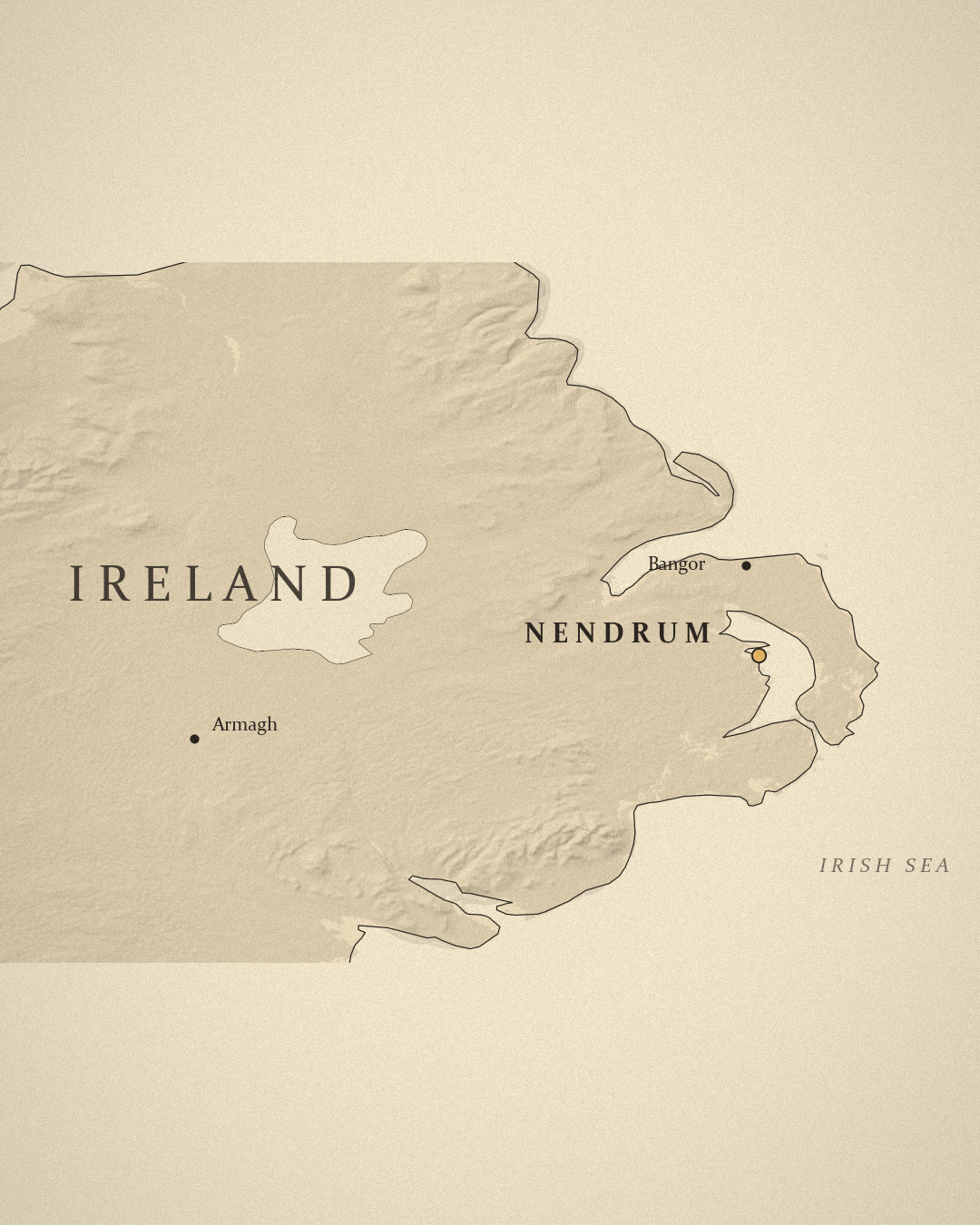
Ireland in the age of the Book of Kells: around 850 AD Irish monks copied a Latin grammar book and filled its margins with real complaints. I am very cold. New parchment, bad ink. A hangover written in ogham, a storm poem on a Viking night, and the curse left on the hardest page. One working day rebuilt from the St. Gall Priscian.
A grammar book from Ireland
Around 850 AD, in a monastery on the coast of County Down, Irish monks copied out a large Latin textbook: the Institutiones Grammaticae of Priscian, the standard grammar of the Latin language. Latin was the language of scripture and scholarship, and an Irish monk learned it as a foreign tongue. A grammar like this was a working tool, used hard and often.
Their copy survives. It is known today as Codex Sangallensis 904, the St. Gall Priscian, after the Swiss abbey library that has kept it for most of its long life. Between and around the Latin lines, the copyists and their colleagues packed in more than nine thousand glosses, short explanations and translations, and about 3,400 of them are in Old Irish. For linguists, these glosses are one of the main windows into the Irish language as it was spoken more than a thousand years ago.
The margins carry something else too. Alongside the sober scholarship, the scribes wrote notes to themselves. They complained. And because parchment lasts, the complaints lasted.
The complaints
'I am very cold,' says a note on page 114. 'New parchment. Bad ink. Oh, I say nothing more' (page 217). 'The parchment is scanty' (page 228). 'Alas, my hand' (page 176). One scribe asks forgiveness in advance: 'May Máel Brigte not be angry with me for this writing.' Another notes, mid-column, that it is time for lunch.
None of this is theater. An Irish scriptorium in winter was a cold place to sit still, copying was daylight work when candles were dear, and parchment was expensive enough that a scribe with a bad sheet mostly had to live with it. Erasing meant scraping the surface with a knife, and a heavily scraped page grows thin. The complaints in the margins are the working conditions of the book trade at the far edge of Europe, written down by the people doing the work.
The hands change partway through the book. Scholars count two main scribes, with a few minor hands correcting behind them, and the second scribe left a note at the start of his stretch of the text. The complaints, in other words, were a habit of the house, not one man's bad week.
A hangover in ogham
The most famous note sits on page 204. In the margin someone drew a short line of ogham, the old Irish alphabet of strokes and notches that Ireland had cut into standing stones centuries earlier. Read out, the strokes spell latheirt: heavy over-indulgence in ale, and the state it leaves you in. A massive hangover is a fair modern rendering.
Why ogham? By 850 it was a scholar's alphabet, out of everyday use, and that is the charm of the theory: some say the scribe chose letters his master could not read at a glance, a complaint hidden in plain sight. It is a good story and it may even be true. But the same word also appears in the book in ordinary script, written openly, which cuts against the idea of concealment. The episode keeps it as an open question, because that is what it is.
Either way, the note tells you something concrete: a working scribe in 9th century Ireland sat down to a day of fine motor work on a skin of vellum while, in his own word, ale-wrecked. The quill shook. The page got written anyway.
The storm and the longships
On a night when the wind rose, a scribe turned from his Latin and wrote four lines of Irish verse in the margin. Is acher in gaíth in-nocht, it begins: bitter is the wind tonight, it tosses the sea's white hair. I do not fear the fierce raiders who must cross a calm sea.
The logic was simple and real. Viking fleets had been raiding the Irish coast since the 790s, and monasteries, rich and unwalled, were favorite targets. Longships did not cross the Irish Sea in a gale. A terrible night was a safe night, and a man working late by candlelight could hear the weather doing guard duty for him.
The little poem became one of the most quoted pieces of early Irish verse, a snapshot of the Viking age caught in real time. Whether the scribe composed it that night or copied down a verse he already knew, nobody can prove. It survives because he wrote it here, in the margin of a grammar book.
Twelve hundred years
Dated entries in the book let scholars place the work in 850 and 851, and a note on the feast of Mo Chaoi of Nendrum points to the monastery of Nendrum, or nearby Bangor, on the County Down coast. Within a generation or two the book was on the move. Irish monks had been leaving for the continent for centuries as pilgrims and teachers, and they carried their books with them. This one came to rest at the abbey of St. Gallen in Switzerland, a house that traces its story to Gallus, by tradition an Irish companion of the missionary Columbanus, and it has been there ever since.
One habit of these Irish copyists changed reading itself. Classical Latin was written with no spaces between the words. Irish monks, learning Latin from books rather than from the cradle, needed to see where one word ended and the next began, and manuscripts like this one helped spread word spacing through Europe. The gap after every word you are reading right now is their doing.
The book is fully digitized, and anyone can leaf through it online and find the cold scribe on page 114. In the summer of 2025 it went home for a season, lent to the National Museum of Ireland in Dublin for an exhibition on Ireland and St. Gallen, a short journey from the coast where somebody once wrote that the parchment was scanty and the wind was bitter. The curse on one hard page still holds: let whoever reads this sweat. This page is difficult.
Sources
- Pádraic Moran (ed.), St Gall Priscian Glosses, digital edition: the full gloss corpus of Cod. Sang. 904, searchable by page, with the marginal notes.
- e-codices, Virtual Manuscript Library of Switzerland: complete digital facsimile of St. Gallen, Stiftsbibliothek, Cod. Sang. 904, dated 851, origin Ireland (a scriptorium at Bangor or Nendrum).
- Whitley Stokes and John Strachan (eds.), Thesaurus Palaeohibernicus, vol. II (Cambridge, 1903): the classic edition of the Old Irish glosses, marginalia, and verse, including the St Gall notes and the storm quatrain.
- CODECS (A. G. van Hamel Foundation for Celtic Studies): catalog entry for St. Gallen, Stiftsbibliothek, MS 904, with bibliography.
- Damian McManus, A Guide to Ogam (Maynooth Monographs 4, 1991): the standard account of the ogham alphabet, its inscriptions, and its later scholarly life.
- Paul Saenger, Space Between Words: The Origins of Silent Reading (Stanford, 1997): the case that word spacing entered European writing through Insular scribes reading Latin as a foreign language.
- National Museum of Ireland: on Cod. Sang. 904 as a 9th century Latin to Irish 'translation app', and the 2025 Dublin exhibition Words on the Wave: Ireland and St Gallen in Early Medieval Europe, which brought the book back to Ireland.
Tell us in the comments — the next episode is picked from what you ask for.
Subscribe on YouTube Watch the seriesMore from the series

One Letter for Every Sound
The Palace Fell. The Payroll Survived.