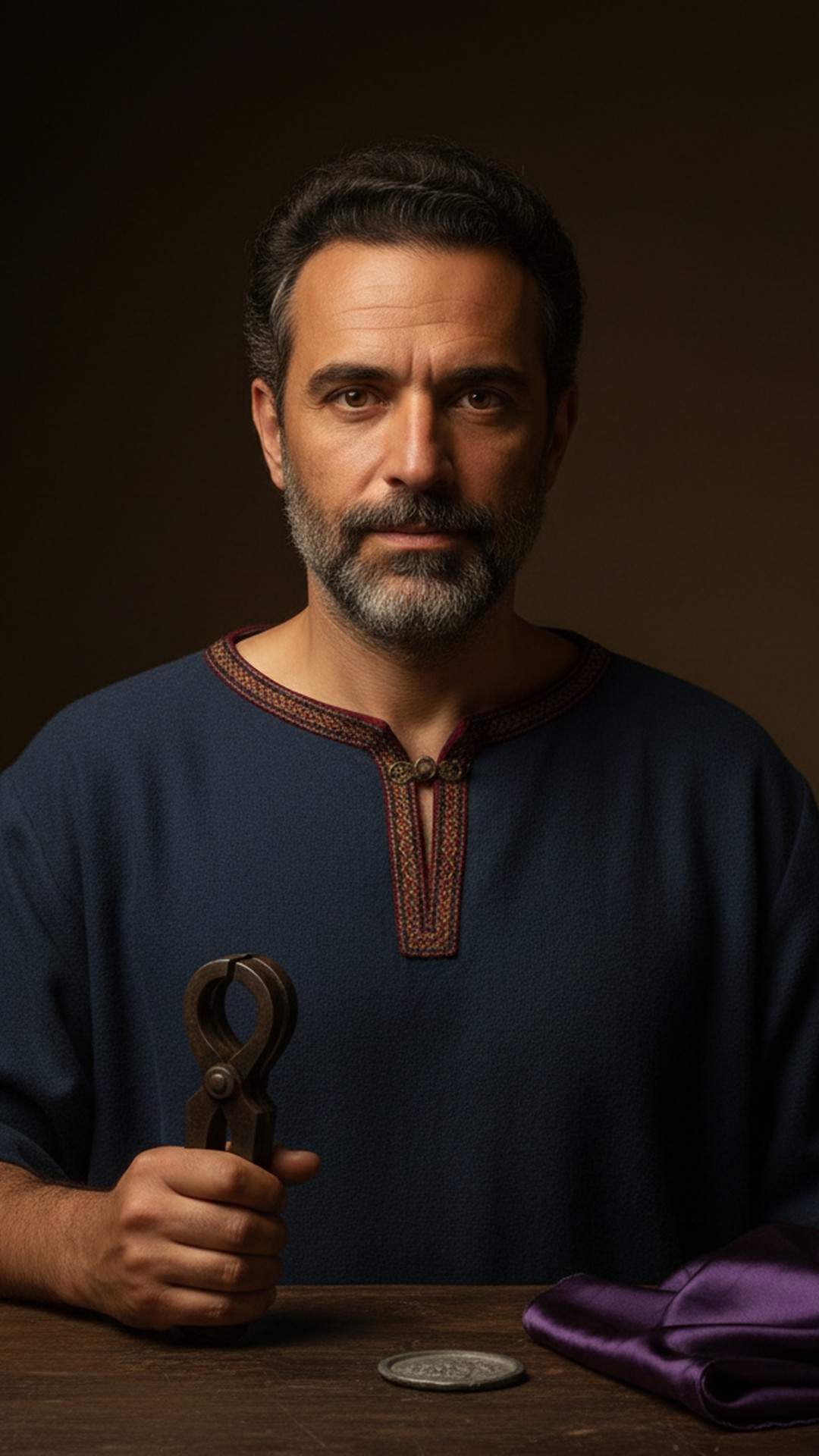
The Ambassador Who Reviewed an Empire
- Civilization
- Byzantium
- Occupation
- Imperial envoy
- Material
- Purple silk & ink
- Period
- AD 968
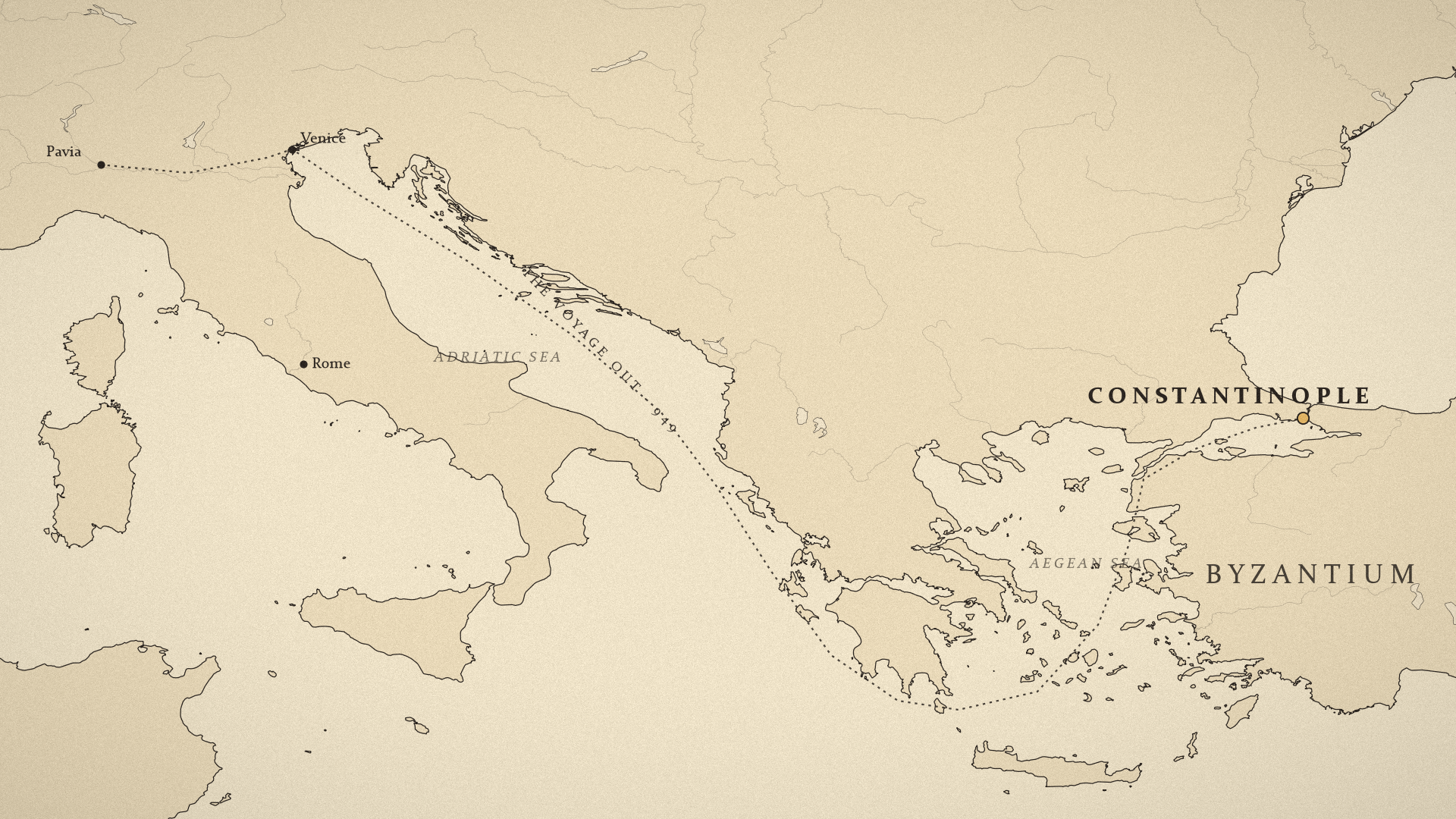
In 968 Bishop Liutprand of Cremona spent 120 days in Constantinople and filed the pettiest official report of the Middle Ages. The full story, from his own file, with every claim checked against F. A. Wright's 1930 translation of the Relatio de legatione Constantinopolitana.
Who was Liudprand of Cremona?
He was born around 920 in Pavia, into a family of Lombard officials who knew the road east well. His father and stepfather had both carried embassies to Constantinople, and the boy grew up in the business of courts, a chorister at the court of King Hugh of Italy, then a deacon and secretary to Berengar II, a man who could draft a letter, quote Cicero, and hold a grudge. It was on Berengar's behalf that he first travelled to Constantinople in 949, a junior envoy in his late twenties watching the greatest city of Christendom put on its show. He broke with Berengar a few years later, crossed the Alps, and attached himself to Otto of Saxony, who made him bishop of Cremona in 961. His revenge on Berengar was a history titled Antapodosis, which means Retribution.
In 968 he came back under worse terms. His employer Otto I, freshly crowned emperor in the West and at war in Byzantine Italy, sent him to ask Nikephoros II Phokas for a purple-born princess as a bride for the young co-emperor Otto II. He arrived on June 4 and left on October 2, one hundred and twenty days later, without the bride. What he took home instead was the Relatio de legatione Constantinopolitana, a report addressed to both Ottos and the empress Adelaide. It is one of the angriest documents to survive from the tenth century, and it should be read for what it is: the losing side's own account, written by a furious and very talented partisan. Almost everything below rests on his word alone.
Did the emperor's throne really levitate?
What he saw in 949 he wrote down in the Antapodosis with an engineer's attention. Before the emperor's seat stood a tree of gilded bronze, its branches filled with gilded birds that sang, each after its kind. Gilded lions flanked the throne, beat the ground with their tails, and roared with open mouths and quivering tongues. And the throne itself rose, carrying the emperor from just above the floor toward the ceiling while the ambassador watched. When it came down again, the emperor was wearing different robes. Liudprand adds, a little smugly, that none of it frightened him, because he had asked around beforehand.
The machines were real. The palace's own handbook, the Book of Ceremonies compiled under Constantine VII, choreographs receptions in the same hall of the Magnaura step by step, down to who stands where and when the organs sound, and it records staging them for envoys from Cordoba in October 946, three years before Liudprand stood in the room. Chronicles of the previous century describe a golden tree, singing birds and roaring golden lions made for the emperor Theophilos, melted down and remade as budgets rose and fell. Behind all of it sat a documented engineering tradition reaching back to Hero of Alexandria, whose Pneumatica, with its working diagrams for singing-bird automata, still survives. The episode shows one of its pages.
The theater had a job. An envoy who has just watched the throne of the Romans ascend toward the ceiling has been told something about the empire before the first word of business, and told it in a language that needs no interpreter. Liudprand's insistence that he was unimpressed is best read as part of the same conversation, a diplomat answering a machine in writing, a decade later, in the only forum where he could win.
An empire of protocol
It is easy to read the 968 report as a catalogue of petty insults, because that is how its author filed it. But almost every insult in it was, from the Byzantine side, the correct application of written rules. The court seated envoys by rank, kept sworn treaties establishing that rank, and when challenged did not argue, it produced the document. The Book of Ceremonies is exactly this instinct at book length, the conviction that the empire's order was written down and non-negotiable, even at dinner.
The quarrel underneath had one word at its centre. Since Charlemagne's coronation in 800 there had been two courts in Christendom calling their ruler emperor of the Romans, and Otto's coronation in Rome in 962 renewed the problem with a Saxon accent. Constantinople's position was that there was one Roman emperor, and that he lived in Constantinople. Otto's position arrived armed, since his troops were pressing Byzantine territory in southern Italy while his ambassador asked for a princess. Liudprand reports that midway through his stay, letters arrived from Rome addressing Nikephoros as emperor of the Greeks and Otto as august emperor of the Romans, at which point his hosts' patience, never generous, gave out entirely.
The lodging and the ledger
The embassy was housed in a marble hall that Liudprand says kept out neither cold nor heat, had no water, and stood far enough from the palace that the delegation arrived breathless, because they were made to walk. Of the official assigned to watch them he wrote that if you sought his like on earth you would not find him, though you might perhaps in hell. In one entry he records going three weeks without a caller and lists his companions as five lions. He never explains the lions, and no editor since has managed to either.
The report keeps accounts as carefully as it keeps grudges. During a famine his allowance stopped for nine days, and he writes that three gold pieces could not buy one dinner for his twenty-five attendants and four guards. When friends sent bread, wine and fruit, he says the guards poured the food on the ground and beat the men who carried it.
Dinner as an instrument
The catering entries are the report at its most quotable. The wine, he claims, was undrinkable, cut with pitch, resin and plaster, which a Greek reader then or now would recognize as resinated wine meeting an Italian palate. The food came drowned in oil and fermented fish sauce. After one protocol disaster the emperor personally sent the ailing bishop a fat goat stuffed with garlic, onion and leeks, swimming in more of the sauce. Liudprand thanked him for it in writing, with a sarcasm so complete that historians now cite the thank-you as evidence of the quarrel.
Fifteenth from the emperor
At the first state dinner he was seated fifteenth from the emperor, without the cloth of honor that marked a distinguished guest, while his staff did not get into the building at all. He knew his seat number because he counted. Weeks later the envoy from Bulgaria was seated above him, and when he objected, the court did not argue. It produced a written, sworn agreement establishing Bulgarian precedence and read him the clause. For storming out he was sentenced to take his meals with the emperor's servants.
You are not Romans
The conversations went no better. On his third day he was drawn into a quarrel over a single word, because the Byzantine court called Otto a king and reserved emperor for its own ruler. On the fourth day, at Pentecost, Nikephoros told the ambassador of the West in public that his people were not Romans but Lombards. Liudprand's report has him answering on the spot with a speech arguing that since Romulus was a fratricide and Rome began as an asylum for runaways, being called not Roman was a compliment. The exchange survives only in his own telling, where his comebacks are, naturally, undefeated.
His revenge was the file itself. The report's description of Nikephoros, addressed to two emperors and an empress, calls the ruler of the Romans a monstrosity of a man, a dwarf with tiny mole's eyes and a neck scarcely an inch long, whom you would not like to meet in the dark. A bishop filed that as a state document.
What was forbidden about Byzantine purple?
True purple was boiled out of murex sea snails in quantities that made the finished cloth a currency of its own, and Byzantium managed it like one. The deepest grades belonged to the category the Greeks called kekolymena, the forbidden things, goods that could not lawfully leave the empire without a lead seal of authorization. This was not vanity but policy. Purple marked rank inside the empire and marked the empire's favour outside it, and a fabric anyone could buy is a fabric that honours no one. The customs men who opened a bishop's baggage were enforcing monetary policy on cloth.
The entry he never got over is dated September 17. Byzantium treated its finest purple cloth as a controlled good, reserved for Romans and forbidden for export without a lead seal of approval. Palace officials ordered the embassy's baggage opened and confiscated the five costliest purple pieces Liudprand had, with the price notionally refunded. He protested like a lawyer, quoting the emperor's own promise that he might buy any vestments he liked, naming four witnesses to it, and noting that he had understood the emperor's Greek without an interpreter.
The answer he records is the coldest passage in the report. The emperor, it ran, does not win friendship with money but subdues by terror and the sword, gifts and purchases would be treated alike, and every purple vestment acquired must be returned. Half the cloth had been gifts from friends for his church. They took the gifts too. When he pointed out that Venetian and Amalfitan traders carried the same cloth west every season, he was told those carriers would be searched from now on.
The road home and the last page
He was released on October 2 with sealed letters, horses for the men and none for the baggage. The journey home took forty-nine days by land to the coast, then a storm, sailors who deserted, and twenty days detained at Corfu, where officials searched his baggage a second time for hidden purple. The surviving text of the report breaks off in chapter 65, mid-grievance. The last thing the manuscript tradition preserved of this document is an unfinished complaint.
Can we trust the report?
His word had an agenda, and his word is most of what we have. The standard modern check is Leo the Deacon, a Byzantine historian who knew the same court from the inside and who describes Nikephoros as nearly the opposite creature, a general of famous austerity and personal devotion, the most successful soldier the empire had produced in a century. Where Liudprand gives us a mole-eyed monstrosity, Leo gives us an ascetic hero, and the honest reading is that both portraits were painted for a purpose. That is the real lesson of the file, and it is why the claims in this episode carry their sources with them.
Scholars have also asked what the report was for. Henry Mayr-Harting has argued that it is best read not as a private tantrum but as a working document of Ottonian strategy, written to explain a failure, harden a policy, and prepare the court that would negotiate next. Read that way, its excesses are craft. The insults are evidence entered into a brief.
What happened next
Fifteen months after the terror-and-the-sword answer, Nikephoros was murdered in his bedchamber in December 969. Leo the Deacon, whose history is our fullest account, describes the conspirators entering through the empress's quarters and finding the emperor asleep on the floor in front of his icons. His successor John I Tzimiskes made a different arrangement with the West. In 972 he sent Theophanu, a relative of his own house rather than a purple-born princess, and she married Otto II in Rome. After his death she ruled the West as regent for their son. Her marriage charter survives, and anyone who wants to know how the story of the confiscated purples ends can go and look at it. The deed is written in gold ink on parchment dyed purple. The cloth the empire would not sell, it eventually signed.
Liudprand himself was dead within a few years, by some accounts on yet another mission east. The empire that confiscated his silks lasted five more centuries. His complaint file has now outlived it by five more, and is still in print.
Sources
- Liudprand of Cremona, The Works of Liudprand of Cremona, trans. F. A. Wright, Routledge, 1930. Full scan
- Die Werke Liudprands von Cremona, ed. J. Becker, MGH SS rer. Germ. 41, 1915. Latin text
- The Complete Works of Liudprand of Cremona, trans. P. Squatriti, CUA Press, 2007
- Leo the Deacon. 'The History of Leo the Deacon: Byzantine Military Expansion in the Tenth Century.' Trans. A.-M. Talbot and D. F. Sullivan. Dumbarton Oaks Studies 41 (2005)
- Constantine Porphyrogennetos. 'The Book of Ceremonies.' Trans. A. Moffatt and M. Tall. Byzantina Australiensia 18 (2012)
- Mayr-Harting, H. 'Liudprand of Cremona's Account of his Legation to Constantinople (968) and Ottonian Imperial Strategy.' English Historical Review 116.467 (2001)
Tell us in the comments — the next episode is picked from what you ask for.
Subscribe on YouTube Watch the seriesMore from the series
The Flower of the Mackerel
The Men Who Audited the Sky