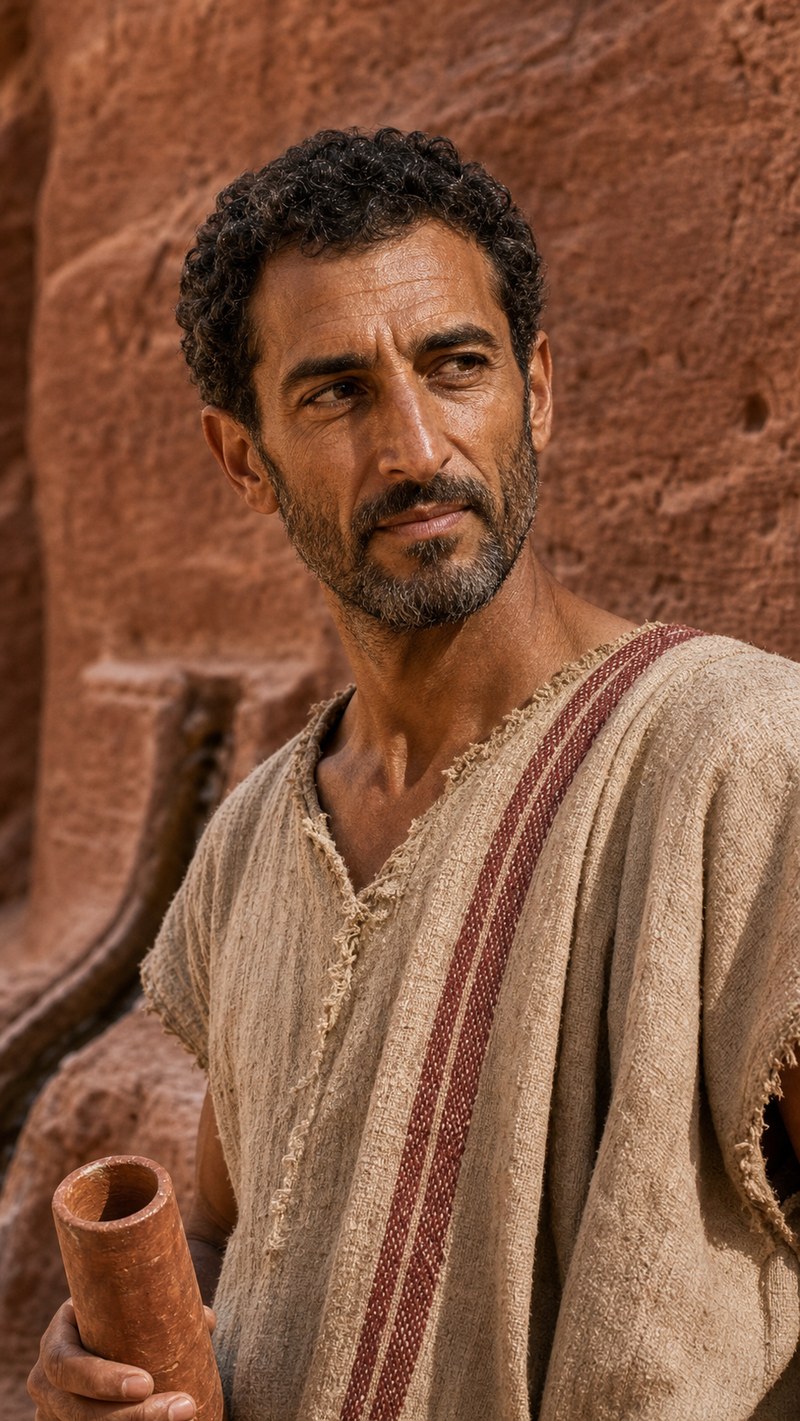
The Men Who Rowed Out to Harvest the Sea's Oil
- Civilization
- Nabataea
- Occupation
- Bitumen harvester (asphalt cutter)
- Material
- Reed, bronze, raw asphalt
- Period
- c. 312 BC
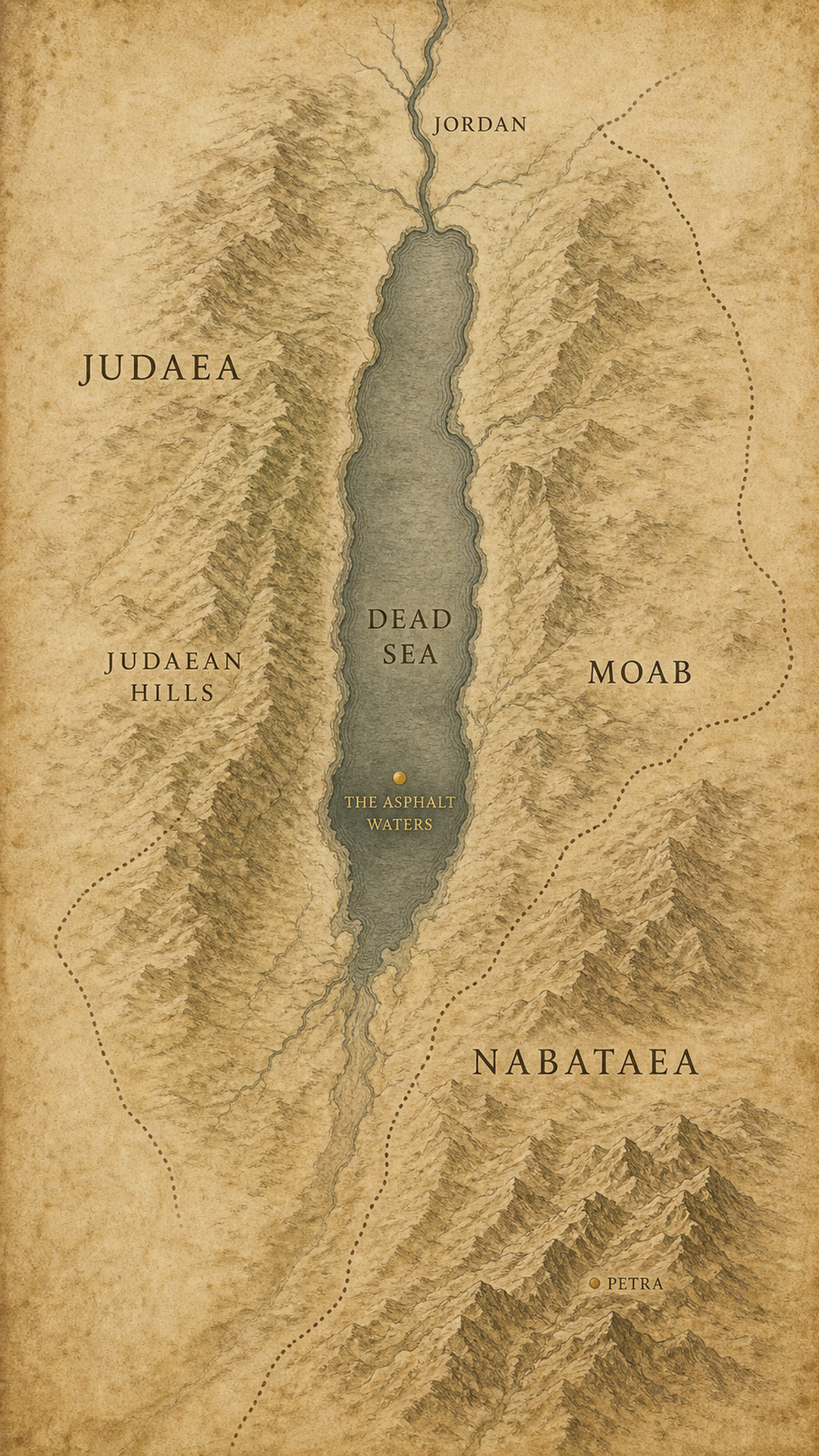
Diodorus of Sicily describes the Dead Sea throwing up masses of solid asphalt so large that from shore they read as islands; the local crews that raced out to claim them worked three to a reed raft — two at the oars, one holding a bow.
A sea that makes islands
The Dead Sea is the lowest lake on Earth and nearly ten times saltier than the ocean — dense enough that a human body cannot sink in it. Antiquity knew it as Lake Asphaltites, the asphalt lake, because at intervals it did something no other water did: masses of solid black bitumen broke loose from the lake floor and rose to the surface, floating like low islands. Diodorus of Sicily, writing in the first century BC, says the locals called a large mass a 'bull' and a small one a 'calf', and claims the biggest spread over three plethra — the size of a small field.
Diodorus presents the eruptions as annual; the geographer Strabo says they came at irregular intervals. The modern record sides with Strabo: floating blocks — some reportedly of many tons — were sighted after the earthquakes of 1834 and 1837, and stray blocks turned up through the twentieth century. Geologists trace the asphalt to organic-rich source rocks beneath the rift valley; buoyant blocks tear free and float because solid asphalt is lighter than the hypersaline brine.
Lake Asphaltites: the Dead Sea's ancient name
Lake Asphaltites is what the classical world called the Dead Sea: the asphalt lake. The name is a product description. Greek and Roman geographers from Diodorus to Strabo knew the lake by its cargo, and Lacus Asphaltites stayed in the geographies for centuries.
European trade knew the region's asphalt as bitumen of Judea, and that name earned a strange afterlife. In the 1820s the French inventor Nicéphore Niépce used light-hardened bitumen of Judea as the photosensitive coating in heliography, the process behind the earliest surviving photograph. The stuff the rafts chased became, at a long remove, a raw material of photography.
Three men, two oars, one bow
The harvest Diodorus describes is startlingly specific. The collectors made rafts of lashed reed bundles and went out no more than three to a raft: two rowed with oars bound to the bundles, and the third carried a bow — because the communities on the opposite shores raced for the same prize and, in his words, carried the asphalt off 'like spoils of war'. Reaching a floating mass, the men climbed onto it and cut it with axes, 'as if it were soft stone', loading the blocks onto the raft.
The detail that no crew went without an archer is the tell: this was a commodity worth fighting over, harvested under threat, generations before any state tried to tax it. If a raft broke up, Diodorus adds, even a man who could not swim did not drown — the water itself held him up.
The war over the harvest
In 312 BC Antigonus the One-Eyed, the most powerful of Alexander's successors, moved against the Nabataeans. After two failed military expeditions against 'the Rock' — probably Petra — his attention turned to the lake: he ordered boats built, and the asphalt gathered centrally as royal revenue. The man he placed in charge, Hieronymus of Cardia, is the reason we know any of this: Hieronymus was a historian, and his lost account is generally accepted as the source behind Diodorus' narrative. The manager of the operation wrote its history.
It lasted almost no time. Diodorus records six thousand men of the region sailing out on their reed rafts and shooting the crews off the collecting boats with arrows. Antigonus abandoned the revenue scheme. The numbers are Diodorus' — no second source corroborates them — but the shape of the event is hard to mistake: a state monopoly attempted on a local extractive resource, and broken by the people who worked it.
Where the tar went
Diodorus states the market plainly: the harvesters 'take the asphalt to Egypt and sell it for the embalming of the dead'. For him the connection was economic gossip; for modern chemistry it is a testable claim. Natural asphalts carry molecular fingerprints — sterane and hopane distributions that survive millennia — and since the late 1980s laboratory work has repeatedly matched the bitumen in Egyptian funerary materials to the Dead Sea's.
The fullest survey, by Clark, Ikram and Evershed in 2016, screened 39 mummies spanning three millennia: bitumen appears in about half of the New Kingdom-through-Late Period individuals sampled and in 87 percent of Ptolemaic and Roman ones — exactly the era of our harvester. It was never universal, and black coatings on mummies are not always bitumen at all; but the trade Diodorus described is now legible in the balms themselves. The Dead Sea was not Egypt's only source — at least one sample traces to an Egyptian seep at Gebel Zeit — yet it was the dominant one.
The word that followed the tar
One more thing traveled with the asphalt: a word. Persian and Arabic knew natural pitch-asphalt as mumiya — a prized mineral drug — and medieval usage gradually transferred the name from the substance to the black-coated Egyptian bodies it was thought to fill. From mumiya comes 'mummy'. The etymology is layered and scholars hedge the details, but the direction of travel is clear: the mummies are named, at some remove, after the tar.
Sources
- Diodorus Siculus, Library of History 19.94-100 — the harvest, the rafts, the 312 BC war (Loeb transl., public domain)
- Diodorus Siculus, Library of History 2.48 — the parallel account of the asphalt lake
- Strabo, Geography 16.2.42-44 — irregular eruptions, reed rafts, the harvest (with the lake misnamed Sirbonis)
- Clark, Ikram & Evershed 2016, 'The significance of petroleum bitumen in ancient Egyptian mummies', Phil. Trans. R. Soc. A 374
- Rullkoetter & Nissenbaum 1988, 'Dead Sea asphalt in Egyptian mummies: molecular evidence', Naturwissenschaften 75
- Harrell & Lewan 2002, 'Sources of mummy bitumen in ancient Egypt and Palestine', Archaeometry 44
- Nissenbaum 1978, 'Dead Sea asphalts — historical aspects', AAPG Bulletin 62 (the 1834/1837 floating blocks, block chemistry)
- Inner coffin of Hapiankhtifi, c. 1981-1802 BC — The Metropolitan Museum of Art (bitumen listed in the medium)
- Bouras-Vallianatos & Kaes 2024, 'Treating with minerals in the Middle Ages: the rare substance mumiya', Medical History 68 — the mummy/mumiya etymology
- Harry Ransom Center, University of Texas — The Niépce Heliograph (the first photograph; the bitumen of Judea process)
Tell us in the comments — the next episode is picked from what you ask for.
Subscribe on YouTube Watch the seriesMore from the series
The Man Who Wrote Down Every Excuse
The City That Could Only Be Fed After Dark