
The Complaint That Outlived the Merchant
- Civilization
- Mesopotamia
- Occupation
- Copper merchant (alik Tilmun)
- Material
- Copper oxhide ingots · inscribed clay tablets · reed cargo ships
- Period
- Old Babylonian, c. 1750 BC
A copper merchant named Ea-nasir bought metal in the Persian Gulf and resold it in the Sumerian city of Ur. We know his name for a single reason: his customers were furious, and in Mesopotamia a grievance was written in clay — which does not burn, rot, or fade. The most famous of those letters is now the oldest recorded customer complaint in the world.
A grievance pressed into clay
Sometime around 1750 BC, in the Sumerian city of Ur, a man named Nanni sat down with a scribe and dictated a complaint. He had bought copper from a merchant called Ea-nasir; the metal delivered was not the grade he had been promised, and when his servant went to sort the matter out he was turned away — through what the letter calls hostile territory — with nothing. "What do you take me for," Nanni demands, "that you treat me with such contempt?" He announces that he will inspect every future ingot himself, in his own yard, and reserves the right to reject each one.
The letter survives because of the medium. A Mesopotamian scribe wrote by pressing a reed stylus into a tablet of wet clay; once dried, and especially once a building burned or collapsed and baked it further, that tablet became almost indestructible. Paper and papyrus rot; clay does not. So an ordinary business quarrel — the kind that leaves no trace in most of history — was fixed in the ground for nearly four thousand years. Guinness World Records now lists it as the oldest known written customer complaint.
The man from Dilmun
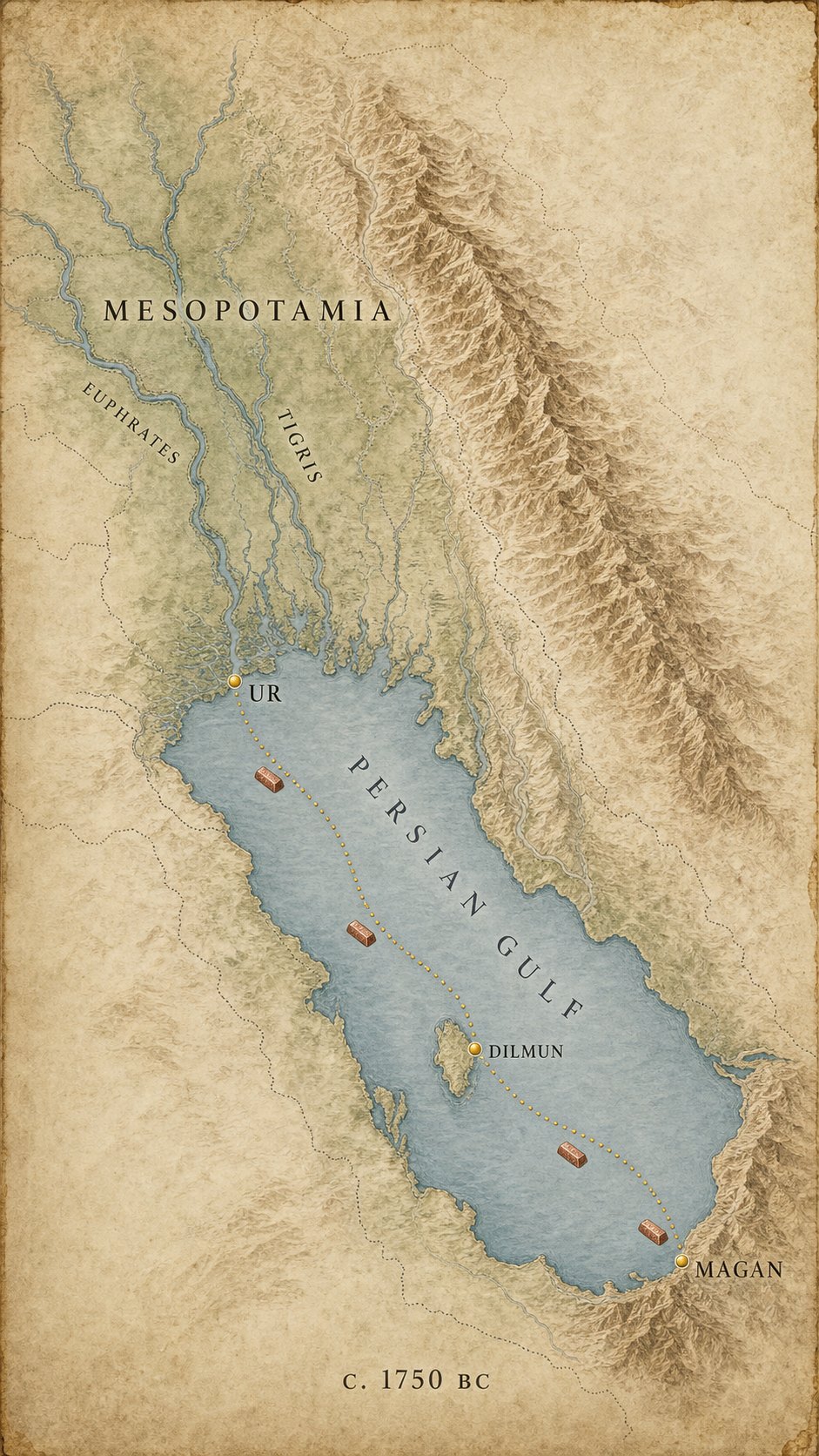
Ea-nasir was what his own language called an alik Tilmun — literally 'one who goes to Dilmun'. Dilmun was the trading island in the Persian Gulf that we call Bahrain, the entrepôt where the copper of Magan (the Oman peninsula) was gathered and sold north. Ea-nasir sailed down the Gulf, bought copper there, and shipped it back up to Ur to resell — sometimes ingots, sometimes finished goods, and, when the opportunity arose, textiles or other cargo. He was, in short, a wholesaler at the far end of a long and risky supply chain.
That distance matters to the story. The copper Nanni was complaining about had crossed hundreds of miles of open water before it reached him, passed through at least one middleman, and been paid for in advance. Whether Ea-nasir was a genuine cheat or simply the nearest man to blame for metal that left Oman already substandard is something the tablets cannot settle. The record preserves the customer's anger, not the assayer's verdict.
The house of Ea-nasir at No. 1 Old Street
Ea-nasir lived and traded around 1750 BC, in Old Babylonian Ur, and we know his street address. The detail that turns a complaint into a comedy is what else was found with it. When Leonard Woolley's expedition excavated Ur in the 1920s and 30s, the tablets that would later be published as Nanni's complaint came from a single house — the dig team labelled it 'No. 1 Old Street'. And Nanni's was not alone. Other letters in the same group scold the same merchant: one correspondent, Arbituram, is still waiting for copper he has paid for; another writes that he is tired of receiving bad metal.
In other words, the man appears to have kept his complaints. Whether he filed them as records of disputed transactions or simply never threw them out, the effect is the same: a small merchant's grievance drawer, sealed by time. Ea-nasir left no monument, no inscription boasting of his deeds, no tomb we can name. The only reason his name has reached us at all is the paperwork of people who were angry with him — the ancient equivalent of a man remembered solely by his one-star reviews.
When did Ea-nasir live?
The tablets from his house belong to the Old Babylonian period, when Ur lay under the kings of Larsa, and the complaint itself is conventionally placed around 1750 BC, in or near the long reign of Rim-Sin. That puts Ea-nasir roughly a century after Hammurabi's birth and some three and a half thousand years before his angriest customer went viral. The tablet Nanni dictated is catalogued as UET V 81, and it sits in the British Museum.
Sources
- The complaint tablet of Nanni to Ea-nāṣir — UET V 81 (British Museum 1953,0411.71). Translation: A. L. Oppenheim, Letters from Mesopotamia (Univ. of Chicago Press, 1967), no. 68
- Ea-nāṣir, an alik Tilmun (Dilmun-merchant) of Ur, and the tablets recovered from his house at ‘No. 1 Old Street’. W. F. Leemans, Foreign Trade in the Old Babylonian Period (E. J. Brill, 1960)
- ‘Oldest written customer complaint’ — Guinness World Records
- Cuneiform tablet: quittance for a loan in copper — The Metropolitan Museum of Art, 66.245.18a (Open Access); the real copper-trade tablet shown on screen
Tell us in the comments — the next episode is picked from what you ask for.
Subscribe on YouTube Watch the seriesMore from the series

The City That Could Only Be Fed After Dark

The Guides Nobody Could Stop